|







|
|
|
ABEL GRIMMER - TOWER OF BABEL - PAGE 3
|
19th-Century Asymmetric Wars |
Who's the bully? |
- The official history books describe the 19th-century as
an era of unprecedented technological progress and
romanticism, yet somehow they totally omit how it was in truth, a
century of incessant glohal slaughter achieved through
non-stop war.
- We're told that all
these wars were disparate conflicts and that they were
separate.
- For example, Britain fought for
colonies and the United States was dealing with internal
contradictions.
- And that China suffered from the Opium
Wars.
- But what if you discovered that all of this is a
blatant lie and that no such disunity existed?
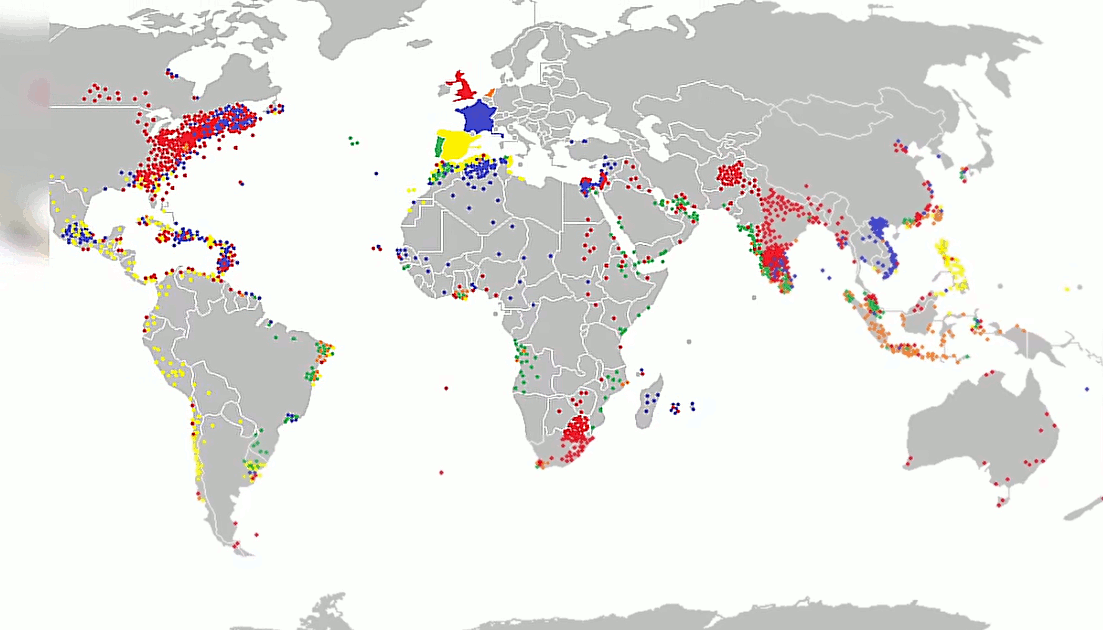
From Old World
Secrets
Wars from
1830 to 1870 |
- Look at a map of the conflicts that took place globally
from 1830 to 1870.
- These were not 'local' skirmishes like
we've been told, this was a single synchronized, global
military operation.
- This was the First World War which
historians deliberately fragmented into dozens of 'minor' wars
to conceal the main enemy.
- Who were the united armies of
the new world order truly fighting against?
- Who were they
actually purging with their bayonets and grapeshot, from
America to China, from Crimea to Paraguay.
- The answer to
this question will overturn your reality.
|
Grapeshot is a historical anti-personnel artillery round, a cluster of small iron balls bound together (like a bunch of grapes) that scattered when fired from a cannon to devastating effect against troops or ships at close range, essentially acting like a giant shotgun shell.
(Assistant)
|
19th-century |
- We're talking about the asymmetrical wars of the
19th-century.
- Wars where one side possessed resources,
logistics and technologies, incomprehensible to the average
person of that era.
- Let's start with the facts which
academic historians have a hard time telling the truth about.
- Open any list of wars from the mid 19th-century, and look at
the dates, 1848, the spring of nations in Europe.
-
Revolutions erupt everywhere simultaneously as if on queue
from an invisible conductor.
War time |
- In 1853, the Crimean War, 1857, the Sepoy mutiny in
India, 1861, the Civil War in America, 1864, the Paraguayan
War.
- 1850 was the beginning of the Taiping Rebellion, also known as the Taiping Revolution, or Movement, was a civil war in China between the Qing dynasty and the Taiping Heavenly Kingdom.
- Doesn't it seem odd to you that the entire world ignited in
war in a single decade?
- The historians will give you many
different reasons, economy, religion, or the struggle for
independence.
|
The Sepoy Mutiny, also known as the Indian Mutiny, was a major uprising in India in 1857–58. It began as a mutiny of sepoys (Indian soldiers) of the British East India Company's army. The mutiny was fueled by various grievances, including perceived cultural insensitivity and oppressive policies by the British.
(gauthmath.com)
|
Fire starter |
- But let's apply logic; when a fire starts
simultaneiously in the living room, the attic and the
basement, you know that these aren't random ignitions from
faulty wiring.
- You need to understand that the house was
set on fire on purpose!
- During the 19th-century, our
world was deliberately set on fire.
- The most terrible,
bloodiest page of this 'cleansing' was the so-called Taiping
Rebellion in China.
- Historians recorded the numbers as
anywhere from 20 or 30 million up to 100 million dead.
-
Think about it, that is more than the entire population of
many modern countries.
Enemy marching |
- We're told that it was a civil war caused by a religious
fanatic, however, how do simple peasants with hoes murder 100
million people.
- Such a scale of genocide requires an
industrial machine of destruction.
- It requires artillery,
logistics and resources that the rebels simply could not have
possessed.
- If we look aat photographs and engravings of
destroyed Chinese cities from that time, we won't see any
trace of fire, but instead, ruins reminiscent of the aftermath
on the scale of 20th-century carpet bombings or even nuclear
war.
Rocks |
- Entire blocks of stone buildings that were totally
pulverized and turned to gravel.
- You have to wonder who
possessed such power in the mid 19th-century and who exactly
were they destroying?
- Some question whether China was
really a backward agrarian country that the historians claim.
- But instead, one of the last strongholds of an ancient
civilization.
- The great Tartary of great Asia which
preserved remnants of ancient technologies and knowledge.
|
Tartary was a historical European term for a vast, vaguely defined region of Central and Northern Asia inhabited by various Turkic and Mongol peoples (Tatars), appearing on maps from the 13th to 19th centuries, referring to lands from Eastern Europe to the Pacific, like Chinese Tartary (Manchuria, Mongolia, Xinjiang, Tibet) or Siberia.
(Assistant)
|
Revolt operation |
- The Taiping Rebellion was a cover operation under the
guise of suppressing a revolt.
- Western powers together
with the Manchu dynasty annihilated the indigenous population.
- A population that remembered their true history and
possessed skills that were considered dangerous to the new
'masters' of the world.
|
The Manchu Dynasty refers to China's last imperial dynasty, the Qing Dynasty (1644–1912), established by the Manchus, a non-Han people from northeast Asia who conquered the Ming Dynasty and unified China, creating the largest Chinese empire in history, known for its multi-ethnic rule, cultural achievements, and eventual decline leading to modern China.
(Assistant)
|
Civil war |
- Meanwhile, on the other side of the world, in America,
the Civil War between the north and south.
- We've been
lied to since childhood and told that this was a war for the
liberation of slaves and that it was the 'noble' north against
the slaveowning south.
- However, when you look at
photographs of the ruined cities of the south, Richard,
Atlanta, Charleston.
- Look closely at the images and
you'll see brick shells of buildings without roofs, scorched
neighborhoods, and protuding skeletons of buildings.
Tent city |
- This is not the result of field artillery and
cannonballs of that era left holes in walls, that's it.
-
They did not raze entire neighborhoods down to their
foundations.
- The nature of the destruction resembles
Dresden or Hiroshima.
- What if the real purpose of the
Civil War in America was not about anything 'civil' but was
instead the northern army performing the function of ethically
cleasning a territory.
- A territory where citystates, part
of the old world's global system were located.
- If you
look at the real story, the south was agrarian and very
wealthy and the architecture was ancient and majestic.
- To
the extent that it would be impossible for colonists arriving
in wagons to build anything so grand.
Cliff |
- These cities were destroyed to erase the memory of who
really built them.
- So what really happened, they were
wiped out and the population was simply replaced.
- Pay
attention to the 'strange' statistics about the actual
casualties.
- Notice that the numbers seem to change and
seem to be increasing through the years as everyone reexamines
what really went on.
- Initially they calculated the number
so low it was inconsequential and then over the years increased it to a million.
- However, if you really investigate the demographics, it
appears a much larger proportion of the population is missing.
|
The Civil War was the deadliest conflict in U.S. history, with an estimated 620,000 to 750,000 deaths. The older, commonly cited figure of 618,222 deaths has been revised to as high as 750,000 based on new analysis of 19th-century census data. The high number of fatalities is due to both battlefield deaths and diseases, which killed the majority of soldiers.
(Assistant)
|
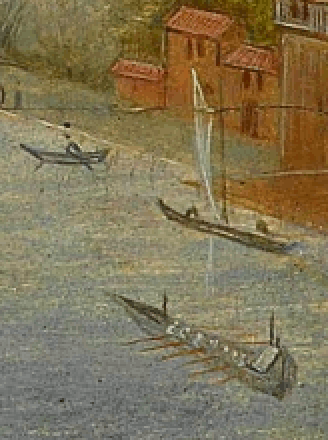
Black sea |
-
The Crimean War was fought between the Russian Empire and an alliance of the Ottoman Empire, the Second French Empire, the United Kingdom of Great Britain and Ireland, and the Kingdom of Sardinia-Piedmont from October 1853 to February 1856.
- During this
war, we're told that Russia clashed with a coalition of
Britain, France and Turkey.
- But why would the world's
greatest empires send their fleets into the landlocked Black
Sea to beseige one city, Sevastapol.
- On top of that, this
went on for several years so the historical narrative about
this control over the Straits is not real.
|
Geopolitical causes of the war included the "Eastern
question" (the decline of the Ottoman Empire),
expansion of Imperial Russia in the preceding
Russo-Turkish wars, and the British and French
preference to preserve the Ottoman Empire to maintain
the balance of power in the Concert of Europe. The
war's proximate cause was a dispute between France and
Russia over the rights of Catholic and Orthodox
minorities in Palestine.
(Assistant)
|
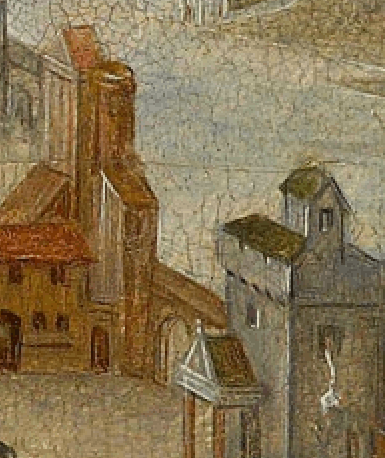
Fortress |
- Such a concentration of army resources and forces for
one point on the map is absurd from a military perspective.
- Unless the true goal was entirely different.
- Look at
the bastions of Sevastapol before its destruction, these are
cyclopean structures carved deep into the rock.
- They
contain underground communications that could not have been
built with a pickaxe and shovel, especially under enemy fire.
- Sevastapol, like many other star fortresses around the
world, was built like an ancient infrastructure.
- It was
an energy hub and logistical center.
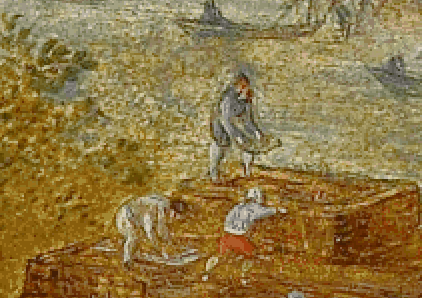
Destroyed |
- The full details aren't really known, but it is
recognized that the coalition relentlessly wiped it off the
face of the earth with what appears to be manical persistence.
- They bombed it not to capture it, but to totally destroy it,
to level the city to the ground.
- In order to turn
antiquity into a pile of rubble.
- Also pay attention to
the soldiers' uniforms; French, British, Sardinians, they all
look identical, as if they all bought their uniforms at the
same store.
- They appear to be a very standardized
invasion army and they're fighting against similar soldiers in
the same uniforms.
- It appears they are a fixed match where two armies
destroy an ancient city, and at the same time, dispose of the
'surplus' population (soldiers) of their own countries in
senseless, bloody assaults.
- If you look at the most
tragic and senseless conflict, the Paraquayan War.
- The war began in late 1864, as a result of a conflict between Paraguay and Brazil caused by the Uruguayan War.
|
The Paraguayan War, also known as the War of the Triple Alliance,
was a South American war that lasted from 1864 to
1870. It was fought between Paraguay and the Triple
Alliance of Argentina, the Empire of Brazil, and
Uruguay. It was the deadliest and bloodiest
inter-state war in Latin American history. Paraguay sustained large casualties, but even the approximate numbers are disputed. Paraguay was forced to cede disputed territory to Argentina and Brazil.
(Assistant)
|
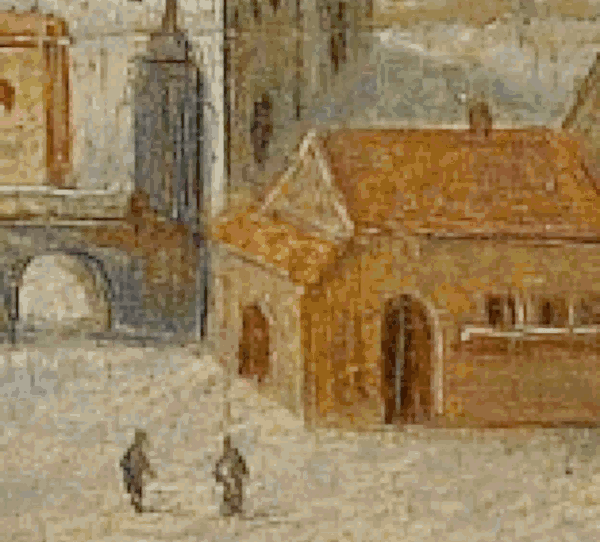
Missing population |
- In 1864, the tiny nation of Paraquay fought against
giants, Brazil, Argentina and Uruguay.
- The outcome of
this war is monstrous, up to 90% of Paraguay's male population
perished.
- This was not a war, this was genocide and a
total cleansing of the territory to zero.
- So what was
Paraguay hiding, historians have discovered that the country
was an incredibly developed, self-sufficient country.
-
They had railroads and telegraphs built without British loans.
- It was a government system that had managed to avoid the
control of London's financial golddiggers.
Refugee |
- But there is another version, Paraquay was a refugee.
- There, hidden deep in the continent were enclaves of that
very previous civilization were preserved, attempting to
survive after a global catastrophe.
- A coalition of
neighbors, armed and financed from outside simply came and
eliminated all people who were carriers of the ancient
genotype.
- Women and children were left to mix their blood
and create a new, obedient people.
- However, the men who
remembered freedom and technology were cut down at the root.
Soldiers marching |
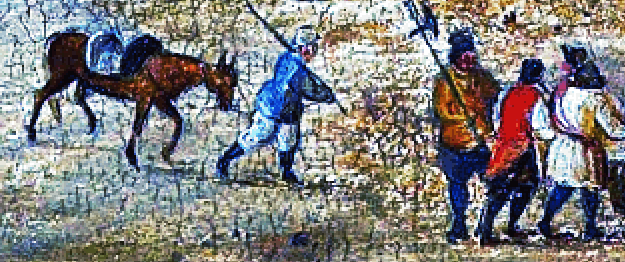
- All of this leads to a chilling reality, the
19th-century was a time when some 3rd force was operating on
earth.
- A force that coordinated strikes, supplied weapons
and rewrote history in real time.
- We see traces of
weapons used that surpass power everything that officially
existed at that time.
- For instance, we see melted forts
in America and Europe and cities buried under several feet of
clay.
- On top of this clay, soldiers in bright uniforms
march, finishing off those who survived the cataclysm.
Cleansing |
- The asymmetry of these wars was not in tactics, but in
the fact that the civilized world was fighting against ruins,
against fragments of a great past.
- They were cleansing
the territory for us, for a new civilization that should
remember nothing that existed before the mid 19th-century.
- To hide the traces of this crime they invented the terms
industrialization, colonial wars and civil conflicts.
- But
you cannot deceive mathematics and the demographic collapses
of that period show that the earth's population decreased not
by percentages, but by orders of magnitude.
Technical means |
- Now we will try and understand what happened and what
technical means were used to accomplish it.
- Let's set
aside emotions, and look at ruthless logistics.
- Military
experts know that war is primarily about supply.
- For an
army of 100,000 to operate effectively in foreign territory,
it needs tons of food, fodder for horses, gunpowder, lead and
medicine daily.
- Official stories tell us that in the mid
19th-century, all of these supplies were delivered on creaking
carts over muddy, dirt roads, or by sailing ships dependent on
the wind.
- However, if we overlay maps of military
operations over maps of the actual terrain and possibility of
that time, we run into an insoluble contradiction.
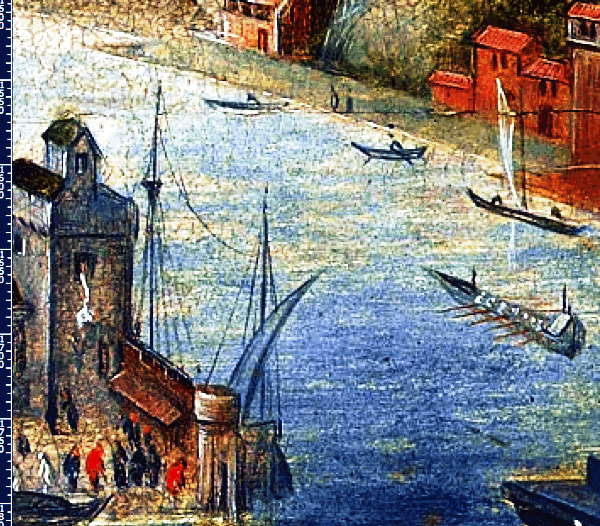
Scale of operations |
- The scale of operations in China, India and America is
technically impossible with the level of transport development
that we are told about in school.
- Take for example, the
so-called colonial conquests; we are told that the British,
French and Dutch sailed to wild shores, planted a flag, and
within a couple of years erected magnificent cities there with
parliaments, train stations, universities and banks.
- Look
at the architecture in places like Melbourne, Bombay, Cape
Town or Hanoi in the mid 19th-century.
- These are granite
and marble colossi with columns, intricate stucco work, and
perfectly calculated acoustics.
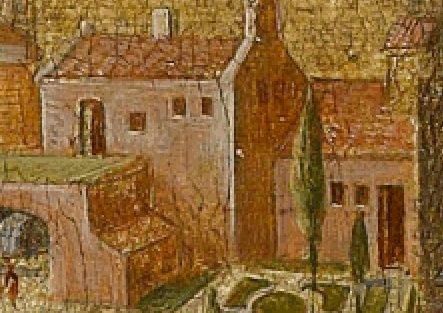
Move in ready |
- Historians tell us that all of this was built by
convicts, soldiers and uneducated local laborers using
primitive winches and hand saws.
- Do you actually believe
that amidst constant revolts, epidemics and a lack of
industrial base, that masterpieces of ancient caliber could be
build in such a manner.
- Or is it more logical to assume
that these cities had already stood there for hundreds,
perhaps even thousands of years, and the colonizers simply
moved into and occupied the empty buildings, put up their
signs and called it 'founding' a city.
- The asymmetrical
wars of the 19th-century were in reality, wars for real
estate, a global corporate takeover.
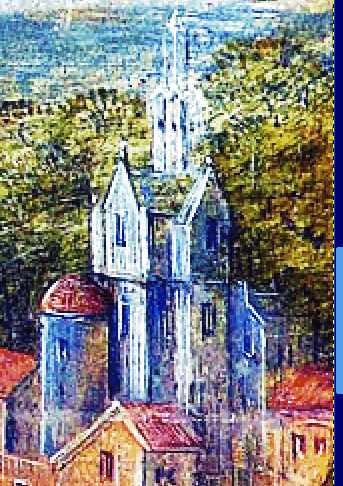
Palace |
- That's why the destruction was so selective.
- Only
those structures that bore clear symbols of the old faith or
old power, or those whose purpose the new masters could not
understand or used, were destroyed.
- Recall the burning of
the Summer Palace in Beijing in 1860, Anglo-French forces
didn't just loot it, they methodically burned down and blew up
this complex over several days.
- Why spend so many
explosives on a palace complex?
- Because the Summer Palace
was not just an emperor's residence; it was a library, an
archive, a repository of technologies and artifacts of great
Asia.
- It wasn't just a palace that was destroyed, it was
a database.
|
The Summer Palace or Yihe Garden was built by the
Chinese Empress Cixi as a pavilion for quiet retreat. It is a vast ensemble of lakes, gardens and palaces in Beijing. It was an imperial garden during the Qing dynasty. Inside includes Longevity Hill, Kunming Lake and Seventeen Hole Bridge. It covers an expanse of 2.9 square kilometers (1.1 sq mi), three-quarters of which is water.
(Assistant)
|
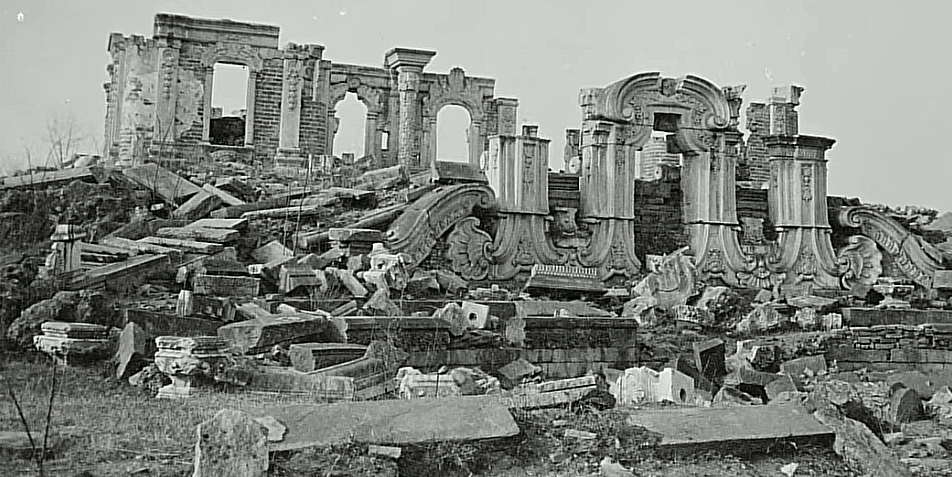
Former palace in
Beijing |
- We are told that the savage Europeans simply wanted to
punish the Chinese but this is a total fabrication.
- This
was technically a hard drive wipe before installing a new
operating system.
- Another shocking aspect is the
photographs from those years, because that same period marked
the birth of photography.
- What do we see in the first
pictures from the Crimean War or the American Civil War?
-
We see strange, empty cities everywhere; St. Petersburg,
Moscow, Paris, Washington.
New master |
- Not a soul on the streets, rare solitary figures who
look like ghosts.
- Historians like to explain it away by
saying that it was long exposure times and early photography
couldn't capture that were moving about and therefore,
blurred.
- Well then why are the trees and lampposts so
focused and sharp and why aren't the shadows of everything
blurred?
- Why do we see clearly standing soldiers in some
photos, but the city around them is deserted?
- It creates
an eerie impression that troops are entering cities that are
already emptied and cleansed of all inhabitants.
Empty city |
- We see cities in which the population had disappeared,
even before the army arrived.
- Perhaps the wars were not
fought against armies, but against the remnants of survivors
after some cataclysm that had devastated these metropolises.
- The armies of the 19th-century were marauders who came to
the ruins of a great civilization to finish off the survivors
and appropriate what remained.
- As example, during the 2003 U.S. led invasion of Iraq, the country's cultural heritage suffered massive damage and looting, particularly at the Iraq National Museum in Baghdad and thousands of archaeological sites.
|
President George W. Bush authorized the 2003 invasion
of Iraq, known as Operation Iraqi Freedom, launching a
full-scale military assault on March 20, 2003, after
giving Saddam Hussein a 48-hour ultimatum to leave,
citing threats from alleged weapons of mass
destruction (WMDs) and links to terrorism, though
these claims were later found to be unfounded, leading
to prolonged conflict, insurgency, and eventual U.S.
withdrawal. (Assistant)
|
First floor windows |
- Note the so-called 'architecture of ruins' popular in
paintings of that era.
- Artists painted ancient ruins not
because it was fashionable, they painted from life.
- The
entire world at that time was littered with ruins, and these
ruins were not ancient in the usual sense.
- They were
fresh destructions, military actions were carried out to
completely level what could not be restored, and to bury the
first floors of what they decided to keep, turning them into
basements.
- This is where the cultural layer of several
feet came from, hence covering the first floor windows around
the world.
Muddy and dusty |
- This did not grow in 100 years, these are the
consequences of an engineering operation to conceal the true
ground level.
- Wars and the burying of cities proceeded in
tactical parallel/
- While some regiments finished off
resistance in the mountains of the Caucasus or the American
prairies, other engineering battalions filled the streets of
European capitals with clay and earth, creating a new
landscape.
- But who was the enemy and who exactly was
being cleansed?
- Look at the maps of Tartary which were
still published in encyclopedias until the mid 19th-century,
and then suddenly disappeared.
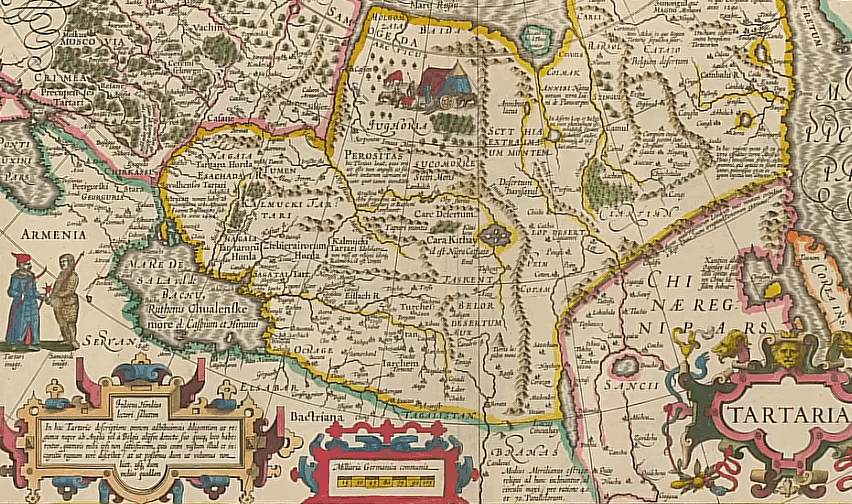
Tartaria map |
- This was a gigantic territory, from the Ural Mountains
to the Pacific Ocean, from the Arctic Ocean to India.
-
This is not a desert, hundreds of cities were document on
these maps but what happened to them, where are they now?
-
Official history claims that nomads lived there in yurts,
however, archaeology, the kind not shown to the general
public, finds the foundations of enormous stone structures in
places like the Siberia, in the steppes of Kazakhstan, and in
the deserts of Turkmenistan.
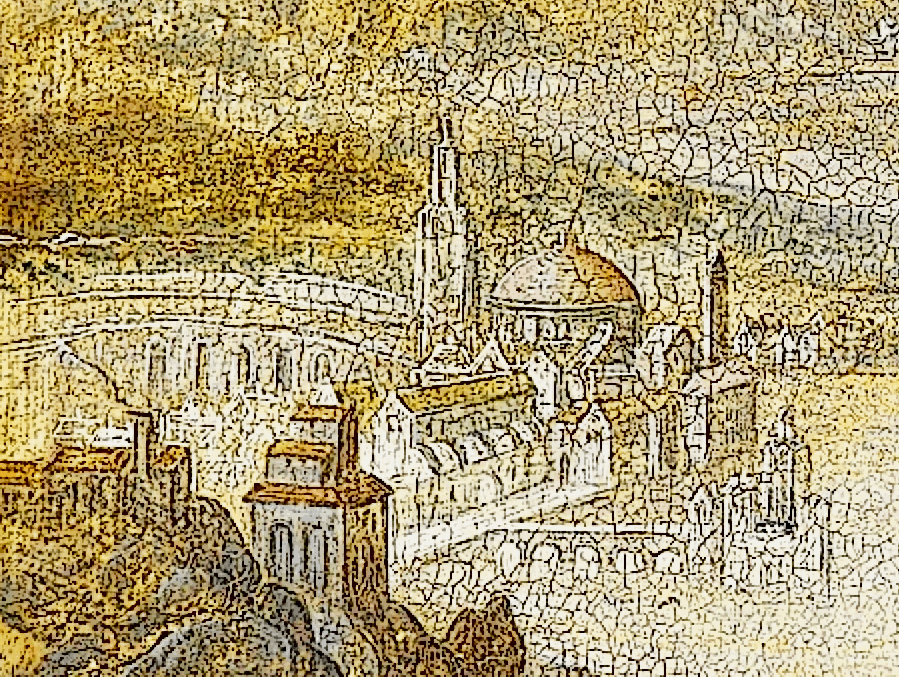
- The asymmetrical wars were
waged against a confederation of free citystates that did not
submit to a single center of power in London or the Vatican.
Vatican control |
- Their technological way of life was different.
-
Perhaps they did not possess firearms in our understanding,
using other principles of defense.
- Things like sonic,
vibrational, energetic which ceased to work after the planets
physical conditions, that very cataclysm.
- Then the troops
were moved in and came to finish them off with primitive but
effective gunpowder and lead.
- And here we come to the
most terrifying question.
- Where did so many soldiers for
these wars come from?
- If the population was partially
destroyed by a cataclysm, where for instance, did the million
strong armies of the North in the U.S. Civil War, or the
colonial corp of Britain actually come from?
Orphans |
- There is a frightening theory about cloning or
artificial human cultivation.
- Remember the strange
orphanages and incubators that were opened enmasse around the
world precisely in that time period?
- A huge number of
orphans whose origins are obscure and these children were
deprived of their real history.
- They were given new
surnames and sent to places like factories to work, and the
army.
- These children were ideal cannon fodder, people
without a past, without ancestral memory, and they were
absolutely obedient to the system.
Global |
- A new army for a new world and their task was to kill
the old humanity.
- Judging by the democraphic gaps and the
change in the ethnic composition of many regions, they
accomplished this task perfectly.
- Prepare for your
skepticism to undergo its most severe test because we have
reached a point of no return in our investigation.
- If
previous facts could still be attributed to coincidences, or
record keepers errors, we will now touch upon things that are
physically impossible to explain within the official paradigm.
Fort |
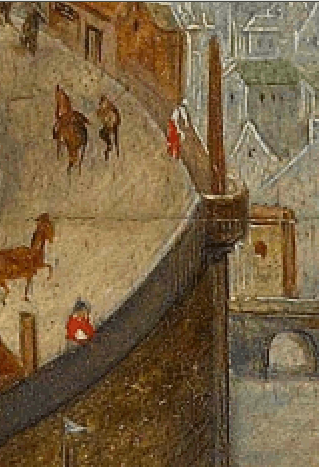
- Let's review the technologies of destruction, look at
the forts and fortresses that were supposedly bombed in the
mid 19th-century.
- Such as Fort Sumpter, Fort Pulaski, and
fortifications near Paris or Kronstadt.
- We are told they
were fired upon with cast iron cannonballs filled with black
powder, however, what we actually see is melted brick and
granite that flowed like wax.
- The melting point of
granite is about 2200°F or 1200°C and brick melts at even
higher temperatures.
- A black powder explosion does not
generate such temperatures even at the epicenter, let alone
enough to melt multifoot thick walls into a vitrious mass.
- This phenomenon is called vitrification and it has been
found everywhere in the ruins of that era.
Explosion |
- This means only one thing, in the so-called wars of that
century, weapons of a completely different class than what
we've been told were used.
- Some have speculated that it
was plasma weapons or high power thermal weapons, the
operating principle of which is unknown to us today or
classified.
- The asymmetry of this war lay in the fact
that one side, the conditional cleaners, had access to orbital
or atmospheric strike technologies, while the defenders, the
inhabitants of the old cities were deprivd of this protection,
perhaps due a proceding global system failure.
High tech |
- Imagine the situation, you live in a high tech city but
your dome is offline, power is gone, and then 'they' arrive.
- Those who call themselves the 'new' power, but they don't
storm the walls and physically attack, but they simply burn
out neighborhoods with directed energy pulses, turning stone
into lava, and occupants into dust.
- Then some 50 years
later, historians would write that it was a fire in an
ammunition depot or an accurate mortar shot.
- Look at the
great fires of the 19th-century; Chicago, Boston, Spokane,
Seattle, Moscow, Kiev, dozens of major cities around the
world.
- All burned to the ground following the same
scenario.
Spark |
- The 'official' version of the story is always laughable;
a cow kicked over a lamp and a spark landed in hay.
- Of
course, from this spark, acres of stone and brick buildings
burned down.
- The fire spread so fast that people didn't
have time to escape from their homes and steel melts and flows
into storm drains and stone into sand.
- But these were not
fires, they were carpet bombings or the use of directed energy
weapons.
- This was a deliberate operation to destroy the
architectural heritage of the previous civilization.
Grid |
- Cities didn't just burn, they were totally annihilated.
- The primitive red brick buildings we now consider historic,
could be built in their place.
- After these fires, city
layouts often changed dramatically with the star shaped street
structures replaced by an easily controllable grid.
-
However, the most terrifying thing lies not in the destroyed
homes, but in the substitution of the very essence of human
existance.
- These were wars against memory because it was
not only homes, but gigantic libraries, archives and museums
burned down all over the world.
- The fire at the Library
of Congress in 1851, which destroyed 66% of the books.
China chronicles |
- Fires in European archives and the destruction of
chronicles and written works in China.
- What exactly were
they burning, they were burning technical documentation.
-
Maps of the real world and lists of the true dynasties,
knowledge of free energy, ether and atmospheric electricity.
- We were thrown back in time and thousands of years of
development, artificially plunged into the age of coal and
steam.
- We were given primitive hydrocarbon burning
technologies instead of the clean energy our ancestors used.
Civitates Orbis Terrarum, Public domain, via Wikimedia Commons
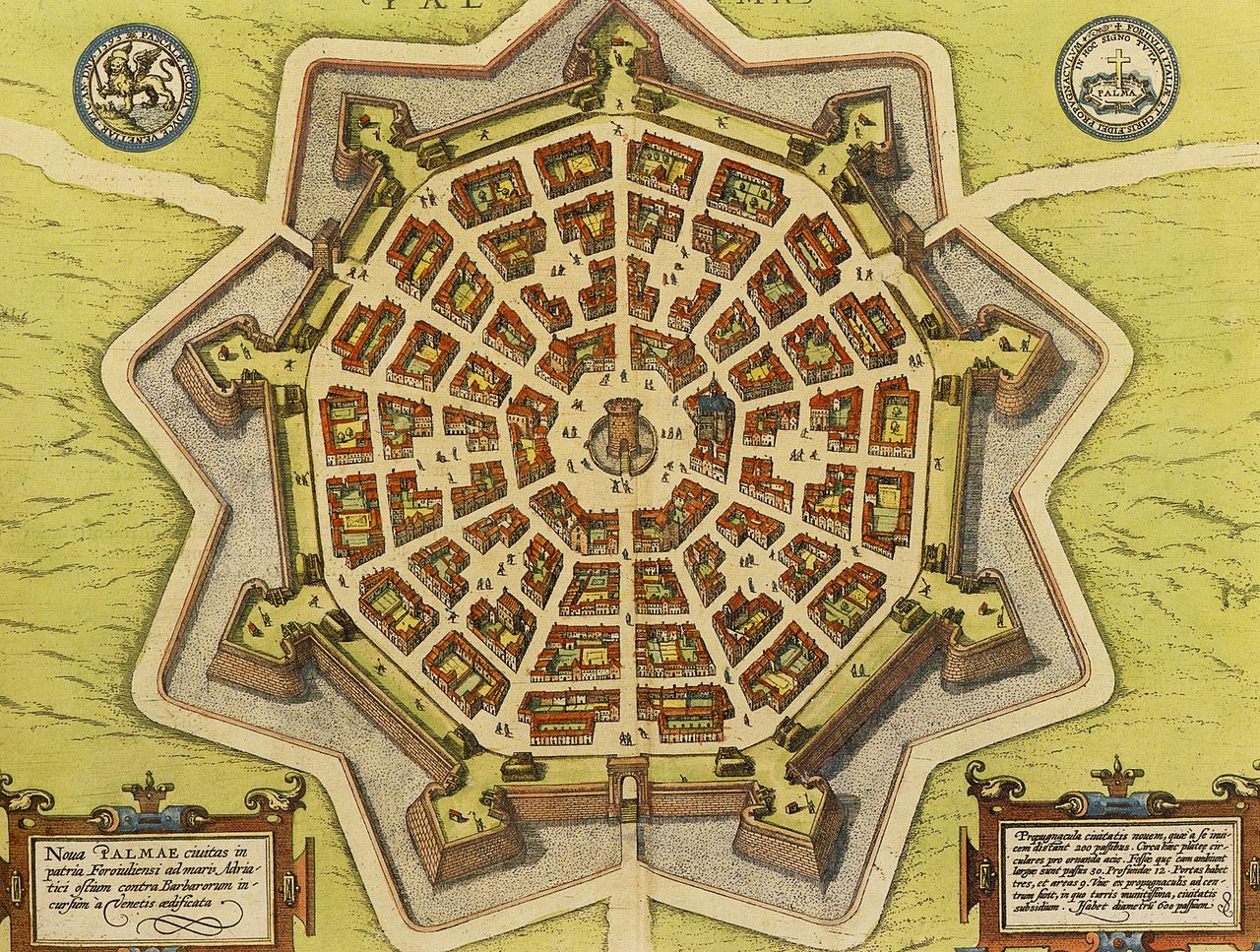
Map of Palmanova in 1593. The town is encircled by massive Venetian defensive systems that are a UNESCO World Heritage Site since 9 July 2017 |
- And so we wouldn't ask questions while looking at
majestic cathedrals and star fortresses, we were told they
were just temples and fortifications.
- In the 19th-century, with the development of more powerful artillery and explosive shells, star forts were replaced by simpler but more robust polygonal forts.
- Although any
engineer looking at the plan of a star fortress would tell
that for defense against infantry and artillery, such complex
geometry is not only unnecessary, but harmful.
- These are
schematics, and gigantic circuit boards lying on the ground
and they were destroyed first and foremost to deenergize the
planet.
|
Star forts, or bastion forts, were military fortifications designed to withstand cannon fire by using angled walls, low profiles, and projecting bastions to create overlapping fields of fire, eliminating "dead zones" and maximizing defense against artillery, serving as crucial defensive strongholds from the 15th to 19th centuries. They evolved from medieval castles, adapting to gunpowder weapons by incorporating earthworks, moats, and complex layered defenses like ravelins to protect cannons and create flanking fire, making them symbols of power and technological prowess.
(Assistant)
|
Population growth |
- Another shocking fact is the explosive population growth
immediately after these bloody massacres.
- Mathematics
fails again here, how can a country's population double in
20-30 years after 33% of its men died in war and diseases and
famine wiped out just as many more.
- This is biologically
impossible because a woman can not give birth to 5 children a
year.
- The only explanation is a massive influx of
population from outside or even more chillingly, the
artificial production of people.
- We have already
discussed orphans, but the scale of the problem is broader,
entire ethnic groups appear that were never on maps
previously.
Population growth |
- Languages were rewritten and in the mid 19th-century
literary languages were created in Europe and Asia.
-
Dialects were unified and new grammatical norms were
introduced.
- People were reprogrammed like computers.
-
The old language which the entire world spoke before the
catastrophe was fragmented into dozens of artificial dialects
to divide us and make us strangers to one another.
- The
principle of divide and conquer was inplemented precisely
then, during the era of the great cleansing.
- We are the
descendants of those who survived this apocalypse, but at a
cost of a complete loss of memory.
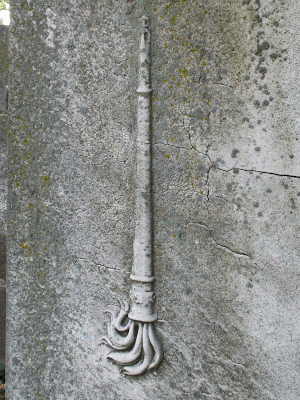
Laurel Hill Cemetery, Philadelphia, PA
Upside down torch |
- Or perhaps, are we the descendants of those who were
settle into empty cities?
- Look at old cemeteries, why do
gravestones carved before the mid 19th-century often lack
crosses and instead are adorned with strange urns, buckets,
inverted torches or solar symbols?
- Why were they so
massively destroyed and replaced with standard slabs?
-
Because the dead cannot lie and old cemeteries could have told
us who truly lived here and how long they lived.
- They
lived perhaps much longer than us and what they believe in.
- The cleansing of cemeteries proceeded in parallel with the
wars.
- It was a war against not only the living, but also
against the dead.
Floodgate |
- The new masters of the world needed a clean history,
starting with dark ages and leading to shining progress under
their careful guidance.
- Consider all the great
inventions; electricity, radio, telephone, automobiles,
appeared in an avalanche at the end of the 19th-century, as if
someone opened a floodgate.
- We are told that this was the
combined genius of lone inventors, but most of these
inventions appeared immediately in a finished state without a
long evolution of prototypes.
- Doesn't it seem to you that
these are simply the permitted remnants of knowledge from the
civilization that had just been destroyed?
- The victors
appropriated the technologies of the defeated, simplified
them, monetized them, and presented them as their own
achievements.
Meeting |
- Tesla, Edison, Bell, perhaps they were not inventors,
but merely talented archaeologists who managed to decipher
some of the surviving technical documentation.
- And what
they couldn't understand, or what was too dangerous for the
powers that be, was hidden or destroyed again.
- The
asymmetrical wars were the final act of a global catastrophe.
- First, the world was engulfed by something terrible, a
flood, a celestial impact, a pole shift, which caused those
very mud flows that buried cities.
- While the survivors
attempted to dig out their homes and rebuild their
lives, the armies of the New World Order arrived.
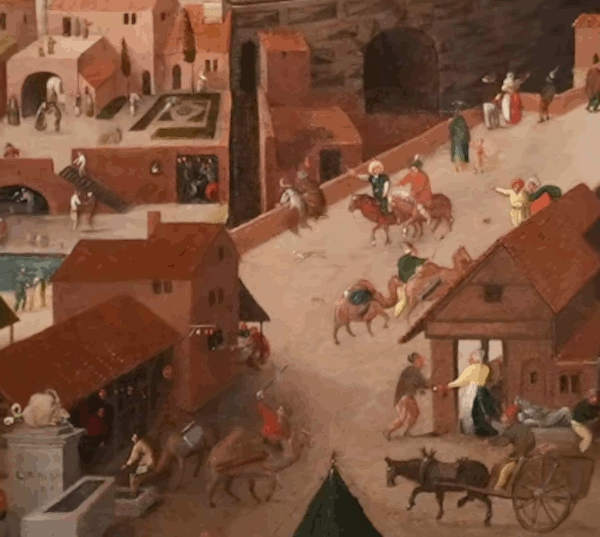
New community |
- They finished off the weakened, they blew up the
surviving power station fortresses.
- They burned books and
they rewrote calendars.
- Perhaps even the chronology
itself was shifted or altered so that we could never reconcile
dates and understand that great antiquity ended not thousands
of years ago, but literally, yesterday.
- All behind the
backs of our great great grandparents.
- We live on the
graveyard of a great civilization and we have been
indoctrinated into believing that we are the pinnacle of
creation.
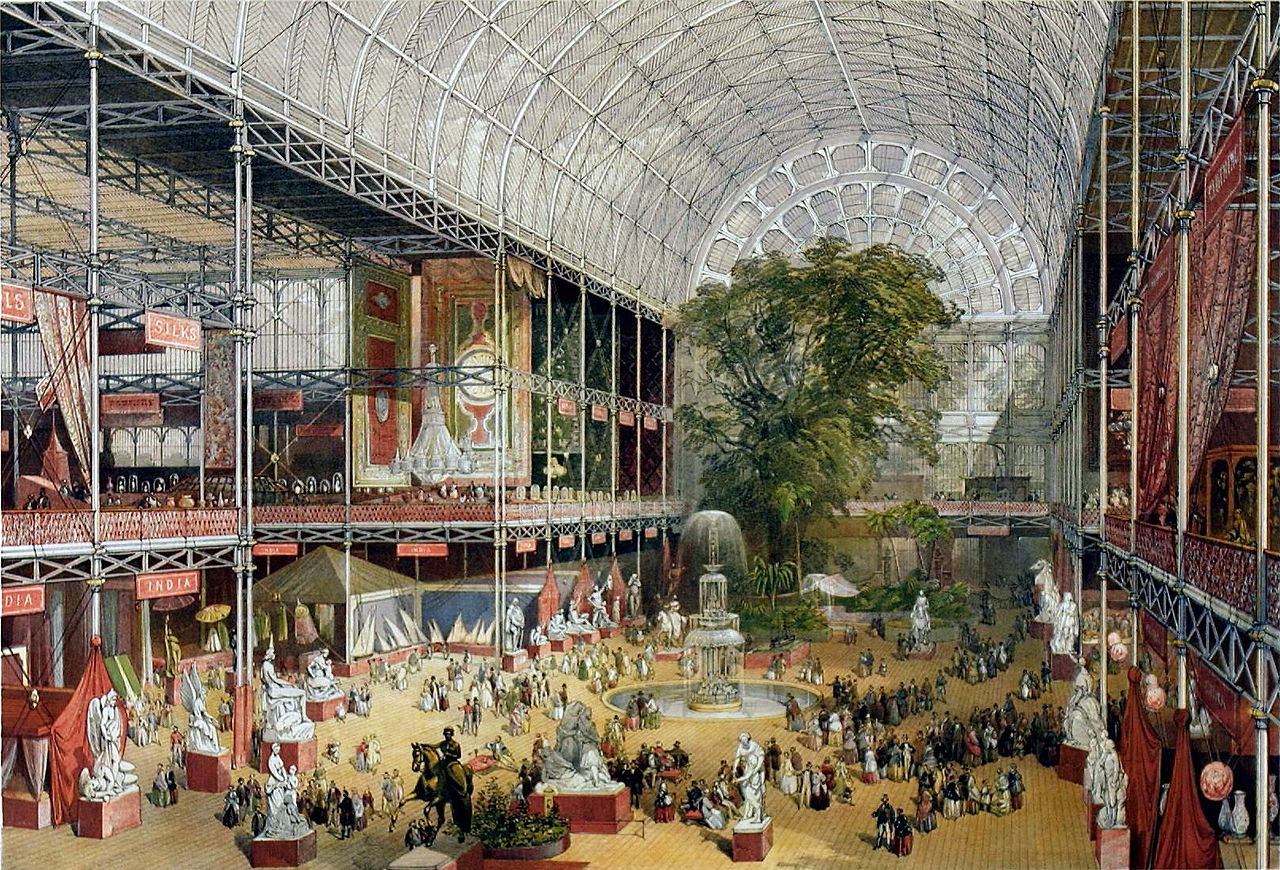
J. McNeven, Public domain, via Wikimedia Commons
Interior of the Crystal Palace at the Great Exhibition in Hyde Park, London, in 1851 |
- But the truth breaks through the asphalt, look at the
so-called World's Fairs of the late 19th-century.
- Paris,
Chicago, St. Louis, Philadelphia; we are told that these
incredible complexes of ancient palaces, bridges, canals,
towers and fountains were built from plaster and tow, for just
one .year to entertain the public and then torn down.
- Do
you believe this, have you seen photographs of their
construction?
- There are practically none, however, there
are photographs of completed majestic cities that surpass
everything we build today in terms of complexity.
- This
includes colonades, sculptures, complex engineering
infrastructure, and all of this was supposedly temporary
scenery.
|
19th-century world's fairs, starting with London's 1851 Great Exhibition in the iconic Crystal Palace, were grand showcases of industrial might, technological innovation (like steam engines, telegraphs), and imperial power, featuring vast exhibits of machinery, art, and products from across the globe, culminating in spectacles like Paris 1889 (Eiffel Tower) and Chicago 1893 (midway, grand architecture) that defined an era of progress, colonialism, and emerging consumer culture.
(Assistant)
|
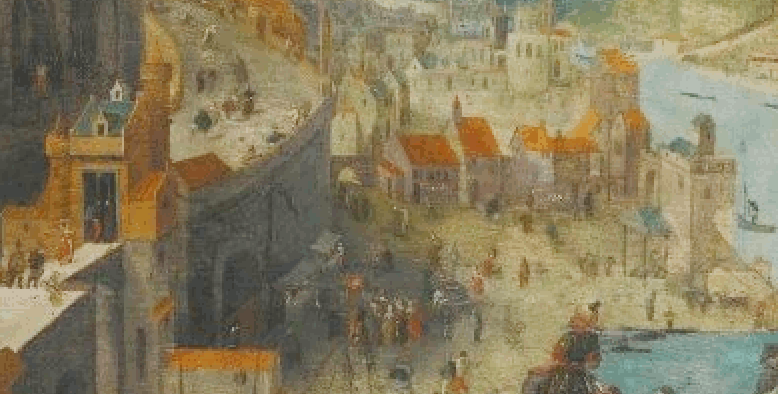
Grandiose
operations |
- It's not believable because World's Fairs were grandiose
operations to legalize appropriation.
- The new masters of
the world found surviving preserved city complexes of the old
civilization, slightly restored them.
- Then they held achievement
exhibitions there showing the 'savage' visitors the remnants
of past grandeur as their own inventions, and then destroyed
them, they blew them up, burned them down, dismantled them for
building materials.
- In other words, they destroyed the
evidence.
- They showed everyone a paradise they could live
in and immediately wiped it off the face of the earth,
accustoming them to the idea that beauty is fleeting and one
should live in practical gray concrete boxes.
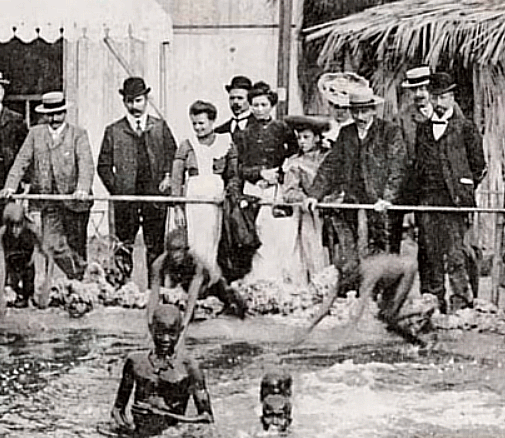
Human zoos |
- So what else was shown at these exhibitions besides
plaster palaces?
- Human zoos, and this was one of the
shameful pages of official history which people prefer not to
remember.
- Such as people who were representatives of
'wild' tribes supposedly brought from colonies were kept in
cages and enclosures, but look at the faces of these savages
in old photos.
- Many of them have 'noble' European facial
features, they're just dressed in furs or rags.
- What if
they weren't savages (not that it makes a bit of difference
it's so wrong).
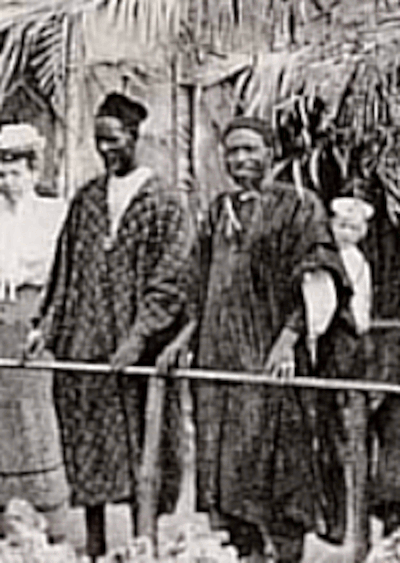
Put on display |
- But what if they were captured survivors of the old
'elite,' stripped of everything and put on display for
ridicule.
- The new power told the crowd that this was
their past, it's savagery, and that they were their future.
- Progress and civilization, we were told that we were
descended from apes, instead we were lowered to a level close
to wild animals.
- Stripped of our divine heritage.
- To
solidify this success, the Prussian education system was
introduced.
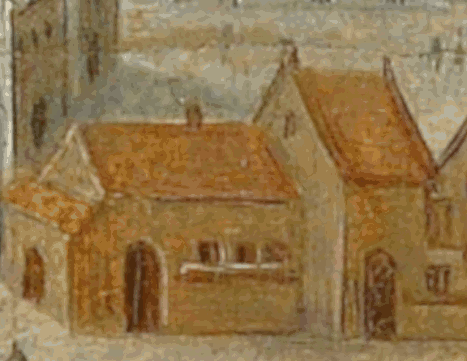
Schools |
- It was precisely in the mid 19th-century that barrack
style schools were introduced worldwide as if on command.
-
Children were separated from their families and herded into
classrooms where they were forced to sit still for hours and
made to memorize approved dogmas.
- This was so the new
power could kill their creativity, erase ancestral memory, to
produce ideal executives, factory workers and soldiers who
wouldn't ask questions.
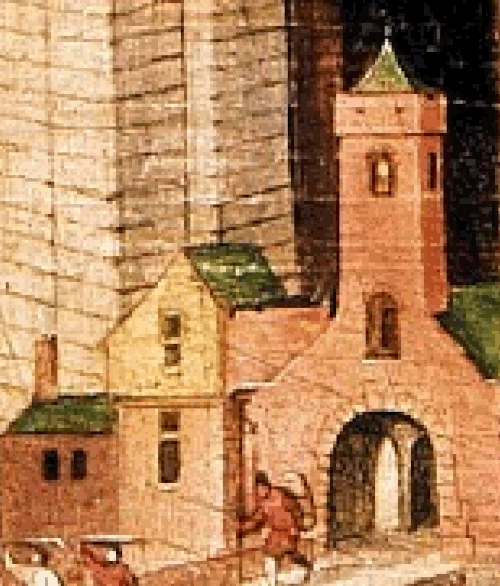
New world |
- There was a bell for the teacher and you had to raise
your hand.
- Strict discipline, this wasn't about
knowledge, it was about training.
- We were taught not to
think, but to memorize and we were taught to believe
authorities instead of our own eyes and intuition.
- Our
physics was replaced, removing the concept of ether, which was
an infinite source of energy that our ancestors used.
-
Instead, we were hooked on hydrocarbons, oil, gas, coal,
resources that can be controlled.
Jailers |
- This entire system of lies rests on our ignorance, on
the fact that we are afraid to look into the abyss of truth.
- We are afraid to admit that official history is the script
of a bad play and that the kings and the presidents of the
19th-century are really just actors appointed by an occupying
administration.
- The revolutions are special operations
for property distribution and that we are orphans forced to
love our jailers.
|
Why was all this necessary and for what purpose was this planetary genocide orchestrated?
(
Old World Secrets)
|
|
|
|
That this lives in thy mind? What sees thou else
In the dark backwards and abysm of time?
Shakespeare,
The Tempest

| |
 |
 |