|







|
|
|
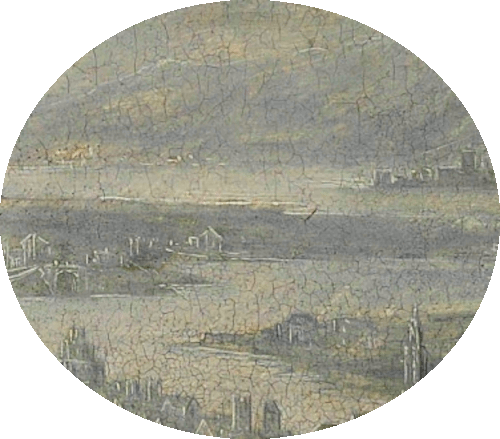
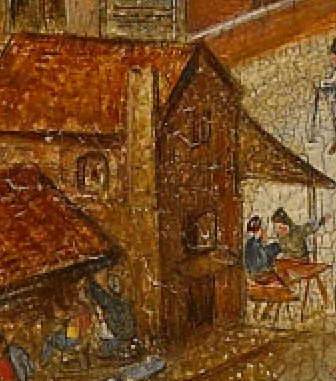
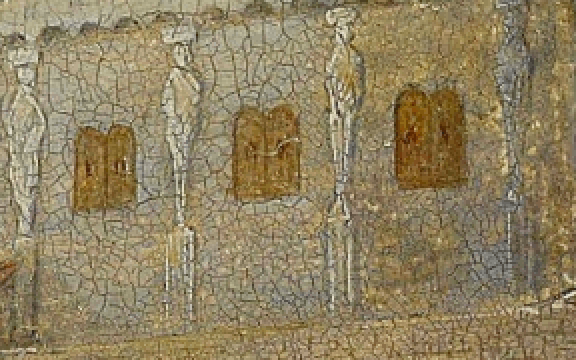
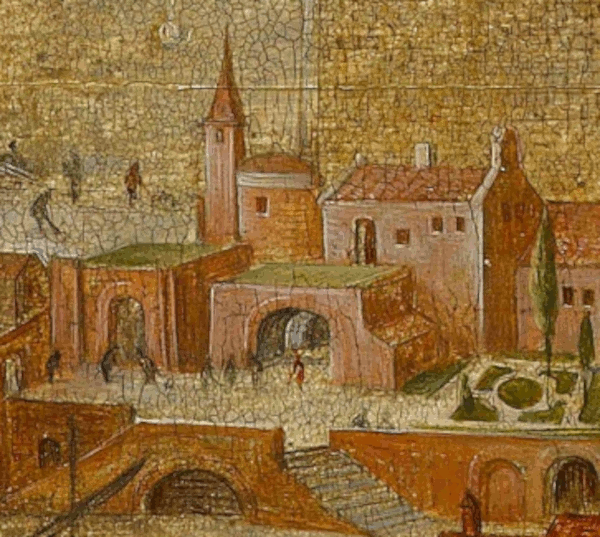
ABEL GRIMMER - TOWER OF BABEL - PAGE 4
|
Sassoon
Narco Dynasty |
Opium |
- The Sassoons were a Jewish family exiled from Baghdad,
but they didn’t just rebuild their lives, they built Shanghai.
- By the mid-1800s, they controlled 70% of all opium entering China, shaping the nation’s fate and rewriting the rules of global trade.
- They didn't just influence Shanghai's economy, they owned it;
the docks, the mills, the real estate, everything.
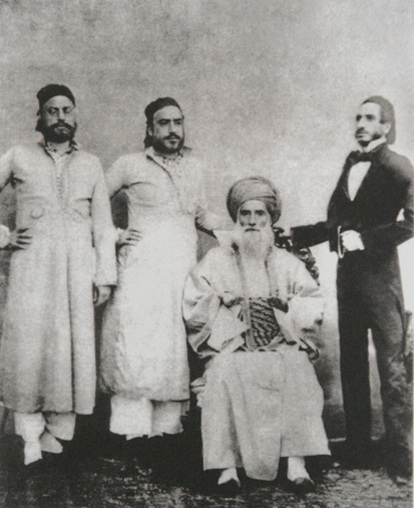
Public domain, via Wikimedia Commons
David Sassoon
and Sons
Elias,
Albert Abdullah,
David, Sassoon David |
- The Sassoon family were associated with finance, banking, capital markets, the exploration of oil and gas, Judaism,
conservative politics, drug trafficking in opium and 'philanthropy.'
- Their principal vehicles, Sassoon & Company and J. Sassoon Financial Group LLC,
were
headquartered in Europe, Asia and North America.
|
The prominent Sassoon family were Baghdadi Jews who were exiled (or fled due to persecution) from Baghdad, starting with David Sassoon around 1830, eventually settling in Bombay and building a vast global trading empire, becoming known as the "Rothschilds of the East" for their immense wealth and influence in opium, cotton, and other trades, linking Baghdadi Jewish communities to India and Britain.
(Assistant)
|
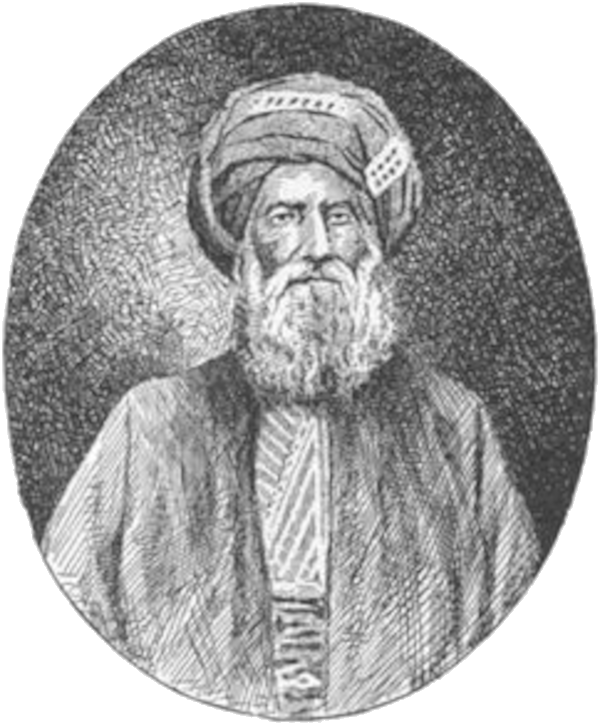
Public domain, via Wikimedia Commons
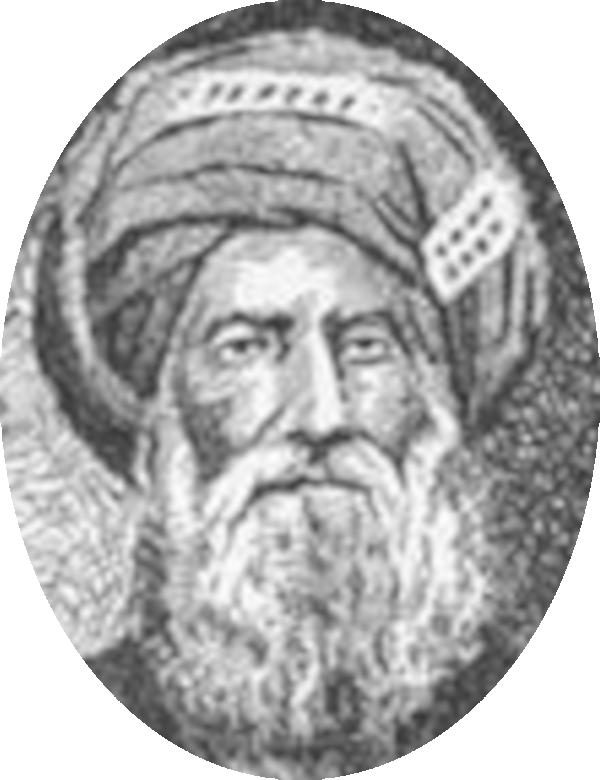
David Sassoon |
- David Sassoon (1792-1834) was a Baghdadi Jewish merchant and philanthropist
(gave money to his causes to change society or build up his
reputation, not for goodwill).
- He served as the treasurer of Baghdad between 1817 and 1829.
- Fleeing persecution, Sassoon and his family emigrated to Bombay
(now Mumbai), British India,
where he became the leader of the Jewish community after the Baghdadi Jews emigrated to the city.
- Sassoon was the founder of the Sassoon family and the founder of David Sassoon and Sons, which later became David Sassoon & Company, a trading company owned by
successive generations of his family.
- His success as a merchant, in which opium played a key role, made him known as the
'Merchant Prince of Bombay.'
- Sassoon also used his wealth for various architectural projects.
|
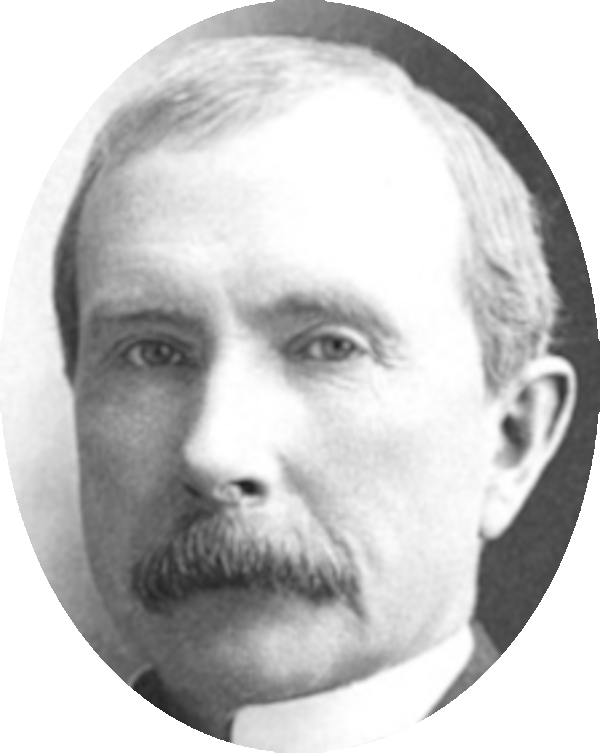
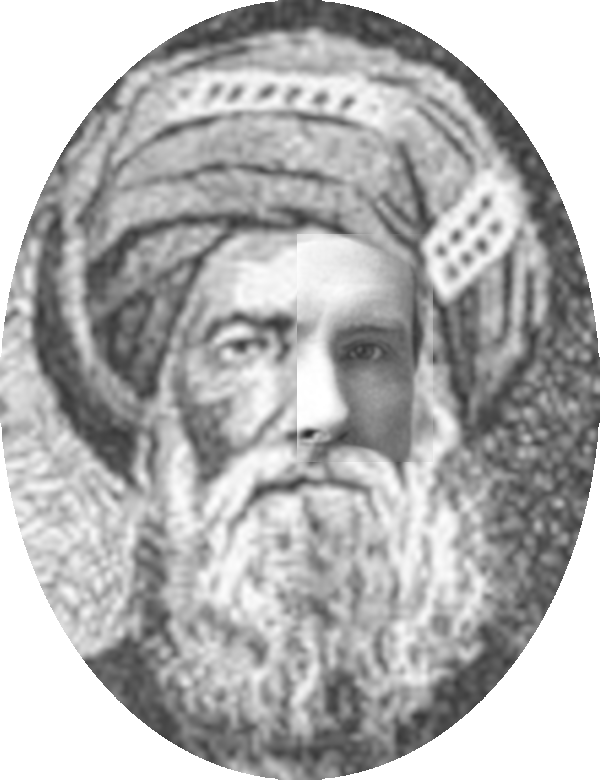
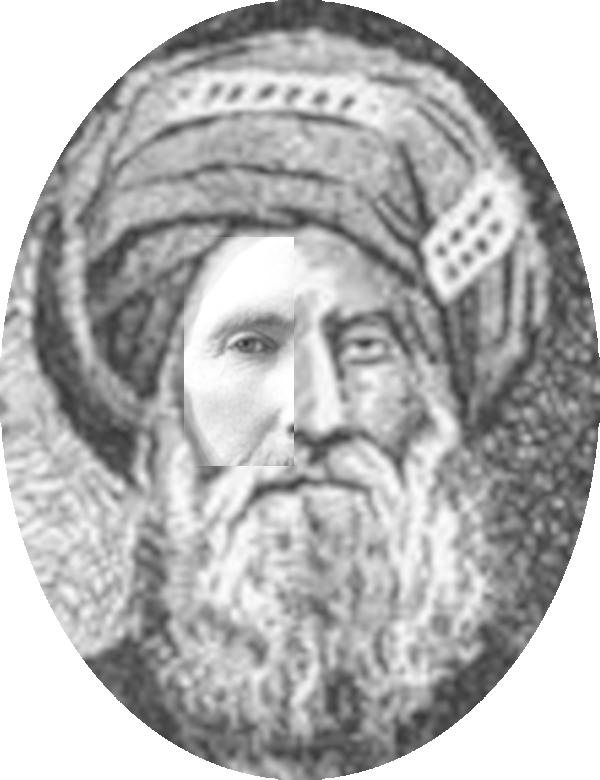
Friedrich Trump as David Sassoon |
 |
 |
Friedrich Trump
1869-1918
3/14 5/30 |
David Sassoon
1792-1834
10
11/7 |
 |
 |
|
Merchant Prince of Bombay |
- This family made the Rothschild's look poor and at their peak
they controlled 70% of all opium flowing into China.
- Here's what nobody tells you about the British Empire's
conquest of China, it wasn't led by the British government.
- It was orchestrated by one family of Iraqi Jewish refugees
who turned opium addiction into the largest fortune in Asian
history.
Opium addicted
population |
- This family addicted an entire nation, made billions,
and built an empire that stretched from Bombay to London and
when it all collapsed, they walked away with their wealth
intact while millions died.
- The British called them the
'Rothschilds of the East' and the Chinese called them
something else entirely.
- Drug lords, colonial parasites and the architects of
China's century of humiliation.
China |
- But what nobody knows is
how they did it, how a family fleeing persecution in Baghdad
became more powerful than the British East India Company.
-
How they manipulated two empires, started wars and built
Shanghai into the Paris of the East, all on the backs of opium
addicts.
- This is the story of the Sassoon family and just
a warning, it's not pretty.
Courtyard house |
- David Sassoon wasn't supposed to be a refugee, in grew
up in one of Baghdad's most prominent Jewish families.
-
His father, Sheikh Sassoon ben Saleh (1750–1830), served as
chief treasurer to the Pasha's, who governed Baghdad under
Ottoman rule.
- The Sassoon family lived in a massive
courtyard house in the Jewish quarter.
- They wore fine
silks and read Hebrew and Arabic and spoke both languages fluently.
-
By every measure, they were Baghdad's Jewish elite.
|
The Pasha's governed Baghdad under Ottoman rule, with notable figures including the Georgian Mamluk founders like Hassan Pasha, who started a dynasty (1704-1723). Later, during the Empire's reform era, Midhat Pasha (1869-1872) brought significant modernization, building infrastructure, schools, and newspapers. Other key governors were the Mamluks like Dawud Pasha before direct Ottoman control resumed, and figures like Ali Rıza Pasha, who ended Mamluk rule.
(Assistant)
|
Ottoman camel |
- The family name meant something and David Sassoon's
father, Sheikh Sassoon, didn't just manage finances.
- He
arbitrated disputes, represented the Jewish community to
Muslim authorities, and controlled access to Ottoman
patronage.
- When you needed something done in Baghdad, you
went through the Sassoons.
- David Sassoon absorbed this
world completely and by his 20s he spoke 5 languages; Hebrew,
Arabic, Persian, English and Hindustani.
- He understood
accounting, trading networks, and most importantly, how to
navigate between cultures.
Conspiracies
everywhere |
- Skills that seemed ordinary in cosmopolitan Baghdad,
would become priceless in the chaos that followed.
-
Everything shattered in 1828, Dawud Pasha, the Ottoman
governor became paranoid.
- He saw conspiracies everywhere
and started confiscating properties and executing perceived
enemies.
- The Sassoons, with their wealth and connections
became targets and their patriarch, Sheikh Sassoon died in 1830.
- Some say
from stress, others claim he was poisoned.
Persian gulf |
- David Sassoon, now age 36, became head of the family and
faced an impossible choice, stay and risk everything, or
flee.
- He ran, first to Bushehr on the Persian Gulf about
1830, however, Persia offered no real opportunities for a
Jewish merchant without connections.
- In 1832, he moved
again, to Bombay, the crown jewel of British India, but you
need to understand what Bombay looked like in 1832.
- It
wasn't in any way the cosmopolitan metropolis it would become
although the British had controlled it for some 170 years.
- David
Sassoon arrived there with his wife and 8 children and
whatever portable wealth he'd managed to smuggle out of
Baghdad.
|
Bandar Bushire (Bushire) is the major Iranian port at the northern end of the Persian Gulf. It is often described as being a peninsular, but the satellite image suggests that in the past, Bushire is more than likely to have been an island.
(archatlas.org)
|
Fort area |
- Sassoon rented space in the Bombay Fort area where most
foreign merchants operated.
- Then he did something
brilliant, he refused to anglicize.
- While other immigrant
merchants adopted British names, British dress and customs,
David Sassoon kept his Arabic name and continued to wear
traditional robes.
- He also had his sons studying Hebrew
and his household remained strictly Orthodox, strictly kosher,
Shabbat observant, Hebrew speaking.
- This wasn't just
cultural pride, this was strategy.
|
The Bombay Fort area (now Mumbai's Fort district) is a historic South Mumbai neighborhood named after old British fortifications, known for its stunning Indo-Saracenic and Victorian architecture, financial hub, and cultural sites.
(Assistant)
|
Community |
- Bombay's economy ran on networks, Parsi networks,
Gujarati networks, British networks, it was all about who you
knew.
- Each community
controlled different trades through bonds of trust and shared
language.
- David Sassoon had a hard time joining British
networks, he was too foreign, and he couldn't penetrate Parsi
networks because he wasn't born into them.
- However, he
could create his own network, a Jewish trading house that
connected Baghdad, Calcutta and Bombay, and eventually Canton
(now known as Guangzhou) in
China.
- His first moves were cautious, he traded cotton, shipped
textiles, nothing dramatic, but he was watching and learning.
|
Parsi, a Zoroastrian community in India and Pakistan, or the Persian language (Farsi) they speak, derived from Persian immigrants to India.
(Assistant)
|
Merchants |
- Sassoon was building relationships with other Baghdadi Jewish
merchants who'd also fled to India, creating a community of
trust in a city where trust was currency.
- His
breakthrough came when he noticed something the British wanted
but couldn't easily obtain, opium distribution networks.
-
The East India Company controlled opium production in Bengal.
- They grew it, processed it, however selling it in China
required different skills.
- It required merchants who
could operate in Canton, navigate Chinese compradors, deal in
multiple currencies and most crucially, operate outside
official British channels because China had banned opium.
|
A comprador or compradore is a "person who acts as
an agent for foreign organizations engaged in
investment, trade, or economic or political
exploitation." An example of a comprador would be a native manager for a European business house in East and South East Asia, and, by extension, social groups that play broadly similar roles in other parts of the world.
(Wikipedia)
|
Wounded |
- The British East India company had a problem for the
most evil business dealings in world history.
- They turned
David Sassoon as a refugee into an asset.
- The company couldn't
use Indian merchants because they would become too powerful
and rebel, and they couldn't hire British merchants, because
the business was so morally reprehensible that even some
company officials wanted 'plausible deniability.'
- The
East India Company needed someone who was desperate, someone brilliant, someone
with international connections and absolutely zero political
power in India.
- They needed someone apparently with no morals
concerning the business dealings, and they found David Sassoon who
was money and power hungry.
Asian ports |
- Sassoon had those skills and his sons all spoke multiple
languages.
- His Baghdad connections gave him credibility
with Middle Eastern traders operating in Asian ports.
-
Additionally, his 'outsider' status, not British or Chinese,
and not beholden to the East India Company, made him a perfect
merchant for the shadow economy of contraband.
- The
company had their first meeting with Sassoon in 1832, you can
only imagine the conversation, breaking the news that the
Chinese had banned opium, but the British wanted the silver it
earned.
-
Sassoon would have understood immediately, this wasn't just
business, this was a license to print money backed by the
British Empire, and all he had to do was surrender his
conscience.
Sissoon and Sons |
- He signed the contract on that very same day and in 1832, David Sassoon & Sons officially opened for
business.
- The firms letterhead was in Hebrew, however,
the business language was Arabic.
- The commodity that
would make them billions was opium, grown in India, shipped to
China and sold to addicts.
- By 1837, just 5 years after
arriving in Bombay, Sassoon had established a permanent agent
in Canton.
- His son Elias Sassoon managed the Chinese
operations but eventually all 8 of his sons came into the
business.
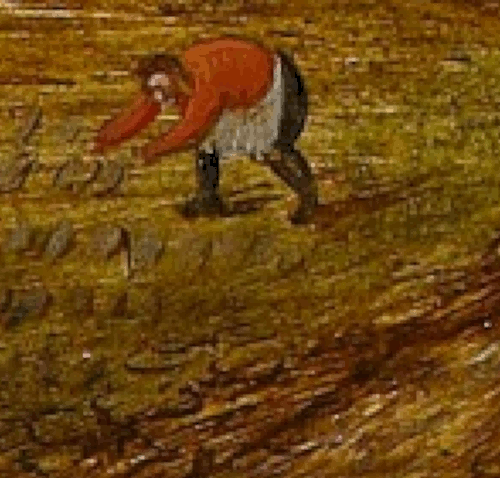
Farming |
- The opium they were pushing wasn't like marijuana or
even cocaine, this was pharmaceutical grade heroin grown on
thousands of acres of land that should have been used to grow
food.
- The British had perfected the system and were
forcing the Indians to grow poppies instead of crops.
-
They would process it in British factories in Bombay and pack it in
chests that contained enough opium to addict an entire
village.
- Then pass it to the Sassoon's who would smuggle
it into China through a network of bribed officials.
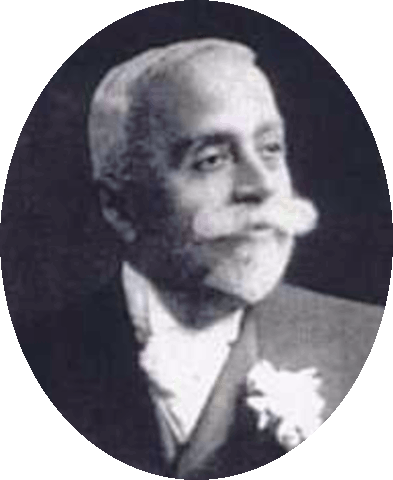
Elias Sassoon |
- David Sassoon's 2nd oldest son, Elias David Sassoon (1820-1880),
was an Indian merchant and banker born in Baghdad.
- He was
also an Iraqi-Indian philanthropist
and Jewish businessman involved in trade in India and the Far East, with branches at Calcutta, Shanghai, Canton, and Hong Kong.
- Eventually, his business, which included a monopoly of the opium-trade, extended as far as Yokohama, Nagasaki, and other cities in Japan.
- He was father to Jacob Elias Sassoon and Edward Elias Sassoon.
|
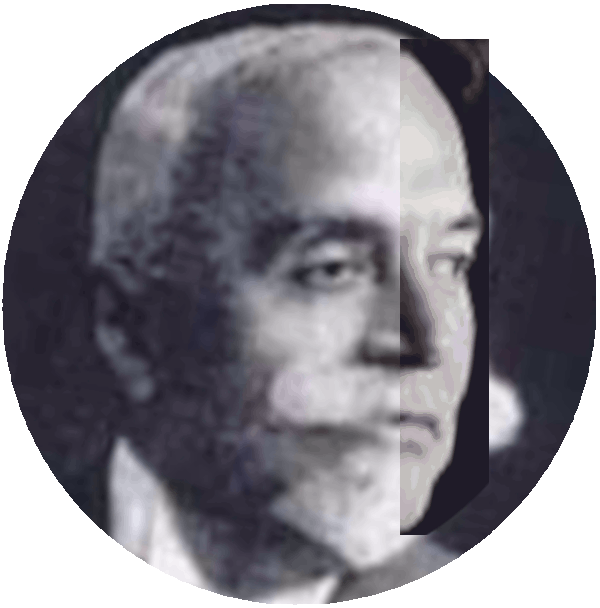
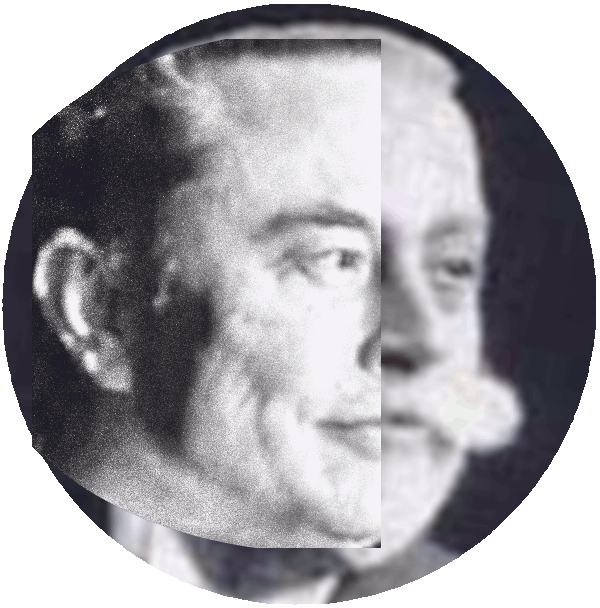
Elon Musk as Elias (Elon) Sassoon |
 |
 |
Elon Reeve Musk
1971
6/28
Emerald miner |
Elias
David Sassoon
1820-1880
3/27
3/21
Drug dealer |
 |
 |
|
Colombo, Sri Lanka |
- Elias (Elon) Sassoon was the first of his siblings to assist the family business' expansion into China when he opened a branch of the business there in 1844.
- He was also involved in his father's business in Bombay, India. In 1867, Elias established his own business based in Hong Kong and Shanghai.
Poppy |
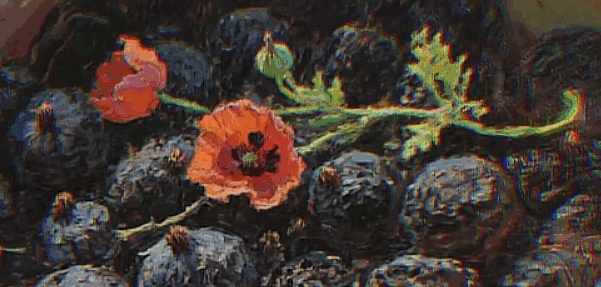
- The family business was no longer about textiles or
general trade.
- Instead, it was about opium, specifically
about becoming the middleman between British production and
Chinese addiction.
- The numbers started small, a few
chests of opium here and there.
- David Sassoon understood
something about this business, the British would go to war to
keep this trade flowing, it was a cash cow.
-
As a result, the Chinese emperor
had banned opium, confiscated foreign stocks and executed
dealers.
- Most merchants would have seen this as a crisis,
something to be avoided, however, the Sassoon's saw it as an
opportunity.
- In 1836, just 4 years after David Sassoon
arrived in Bombay, the company had already shipped 30,000 chests
of opium to China.
- Do the math, that's 3.6 million pounds of opium, enough to
addict every man, woman and child in modern day Chicago.
Opium users |
- When the 1st Opium War erupted in 1839, David Sassoon &
Sons was perfectly positioned, while British traders fled
Canton, the Sassoon's maintained their networks.
- While
other trading firms collapsed, the Sassoon's bought their
contacts, their roots, their Chinese partnerships.
- The
Sassoon't weren't just passive middlemen, they innovated and
optimized, they turned drug trafficking into a science.
-
David Sassoon created a network and put Sassoon family members in every
major Chinese port, they didn't just sell it, they created a
desire for it.
Bribing officials |
- They bribed Chinese officials and hired local
distributors, and they even offered credit to addicts who had run
out of silver.
- Sassoon was running the exact same
playbook that the Sackler family of Purdue Pharma was running 170 years later when
they peddled OxyContin.
- You know automatically there's a
problem when you go to a doctor who doesn't help with your
problem, but tries pushing OxyContin.
|
The Sackler family owned Purdue Pharma, the maker of OxyContin, and faced widespread lawsuits for their role in fueling the US opioid crisis by aggressively marketing the addictive painkiller, leading to accusations of deceptive practices and immense family wealth generation. While they reached large settlements to fund addiction treatment and surrender Purdue, the Supreme Court struck down a key deal shielding them from personal liability, leaving them exposed to future lawsuits and legal battles.
(Wikipedia)
|
White horse |
- In 1839, the Chinese
emperor finally had enough, he appointed Lin Zexu (1785-1850)
who actually had a spine.
- Lin confiscated 20,000 chests
of opium from British and Sassoon warehouses and destroyed it
publicly.
- He wrote a letter to Queen Victoria asking her
if she would allow this drug in her own country and why she
was forcing it on China, the British response, war.
-
That's right, Britain went to war twice to force China to
accept opium imports.
- They called it 'free-trade' but it
was narco-imperialism, pure and simple.
- Lin Zexu traveled to Guangzhou to stem the tide of British opium imports
where he destroyed about 3 million pounds of the drug by dumping it into the city's bay.
- The Emperor endorsed the hardline policies and anti-drugs movement advocated by Lin, but placed all responsibility for the resulting disastrous Opium War onto Lin.
|
Lin Zexu, courtesy name Yuanfu, was a Chinese political philosopher and politician. He was a head of state (Viceroy), Governor General, scholar-official, and under the Daoguang Emperor of the Qing dynasty best known for his role in the First Opium War of 1839–42. He was from Fuzhou, Fujian Province. Lin's forceful opposition to the opium trade was a primary catalyst for the First Opium War. He is praised for his constant position on the "moral high ground" in his fight, but he is also blamed for a rigid approach which failed to account for the domestic and international complexities of the problem.
(Wikipedia)
|
Opium networks |
- By
1842, when Britain forced China to sign the Treaty of Nanking
(Nanjing),
the Sassoon network stretched all the way from Bombay to Hong
Kong.
- They had offices in Calcutta, warehouses in Canton,
agents in Singapore, and destinations in the new treaty ports opening
in far flung places like
Shanghai, Ningbo and Fuzhou.
- The treaty forced China to
open 5 ports to British trade and pay massive indemnities.
- For the Sassoon's this was like Christmas, their shipments
exploded from 30,000 chests to 59,000 chests by the 1850s.
- Let that sink in, a military invasion by the British,
thousands dead, and a proud nation left humiliated and the
main beneficiaries were drug traffickers.
|
The Treaty of Nanking (or Nanjing), signed in 1842, ended the First Opium War between Britain and China, forcing the Qing Dynasty to concede significant rights, including ceding Hong Kong to Britain, opening five ports to foreign trade (Canton, Amoy, Fuzhou, Ningbo, Shanghai), abolishing the Cohong monopoly, paying a large indemnity, and establishing fixed tariffs, marking the start of China's "unequal treaties" era, which eroded its sovereignty.
(Assistant)
|
Golden age of
narcotics |
- David Sassoon's son, Albert Abdullah Sassoon (1818-1896) took over the
business during this golden age of narcotics, and he wasn't
content just being rich, he wanted to be royalty.
- Here's
where the story gets almost comical in its audacity, Albert
Sassoon literally bought his way into the British aristocracy
using drug money.
- Everyone knew it, but nobody cared.
- In 1853, family patriarch David Sassoon became a British citizen something
completely rare for a colonial subject.
Shanghai mud flats |
- After the 5 treaty ports opened, David Sassoon had a decision to make, he could stay in
the established Canton trade, or he could gamble on Shanghai,
which at that time was a city that barely existed, a port that
literally was just mud flats and fishing villages.
- He
sent his 2nd son, Elias (Elon) Sassoon, north to Shanghai with clear
instructions and they established dominance before anyone else
realized how successful this city would become.
- This was just the
foundation because what they built in Shanghai over the next
50 years would make their Bombay fortune look like pocket
change.
Opium den |
- Between 1843 and 1858, David Sassoon transformed from
refugee merchant to the undisputed king of the India China
opium trade.
- By 1850 if you took a stroll through Canton,
you would see thousands of opium dens where 20 years earlier
there were none.
- The smell hits you first, sweet and
acrid and mixed with the scent of sweat and human despair.
- The opium dens were dark, lit by oil lamps and lined with
wooden benches, and the rooms were packed with men in
various stages of consciousness.
Death comes early |
- In the corner, a man who once owned 3 silk shops, is
pawning his last set of clothes for one last pipe; his family
disowned him months earlier.
- At another table, a teenage boy
is experiencing his first high, but he doesn't know it yet,
he's already addicted.
- The chemical hooks are in his
brain rewiring the dopamine and he'll be dead within 5 years.
- This isn't just speculation, old Chinese records
describe these exact scenes.
- They estimated that by
mid-century, 1 in 3 Chinese men were addicted to opium and
every single one of those addictions generated silver that
flowed into Sassoon and British bank accounts.
Bombay rising |
- These first 15 years were the foundation, the
period when the Sassoon trading empire went from small-time
operation to a monopolistic powerhouse.
- The genius was in
the vertical integration, Sassoon didn't just trade opium, he
controlled the entire supply chain.
- Beginning with
production, he established relationships with growers in Patna
and Benares in India, the 2 regions where the East India
Company grew its finest opium.
Competitors
scrambled |
- While other traders bought at auctions in Calcutta, the
Sassoon's negotiated advanced contracts.
- They paid
growers before harvest, locked in prices, for a guaranteed
supply and when opium prices spiked, which happened constantly
as demand in China exploded, the Sassoon's had inventory at
pre-spike costs while their competitors scrambled.
- Then
they got into shipping, and David Sassoon invested in his own
fleet.
- He owned the vessels outright, and this wasn't
about saving shipping costs, though that helped, it was about
control.
Controlled the
ships |
- When you control the ships, you control timing, and the
routes.
- You decide whether to flood the market or
restrict supply.
- The Sassoon fleet grew to 23 vessels by
1850, each one flying the company flag, the traditional Star of David in
blue.
- Next, the distribution network, this is where his
sons became crucial.
- David Sassoon had 8 sons, and each
one managed a different node in the empire.
- Elias ran
Shanghai operations, Abdullah handled Bombay and Calcutta,
Sassoon David managed Hong Kong, and Solomon oversaw Canton
before it declined.
Patrols |
- The company wasn't just a business, it was a family
network where blood ties replaced legal contracts.
- What
is most interesting is that the family operated in a legal
gray zone that was somehow both illegal, but also protected.
- Opium was banned in China and was completely illegal and the
Chinese emperor had made it a capital offense, but the British
Navy actively protected the opium trade.
- British gunboats
patrolled Chinese waters specifically to ensure opium ships
could operate.
- The Sassoon's were breaking Chinese law
with the help of British military protection.
Gray zone |
- The contradiction was the point, the British government
officially opposed the opium trade, but they claimed it was a
private enterprise and had nothing to do with Her Majesty's
government.
- But when Chinese authories seized opium or
arrested dealers, British warships responded with bombardment.
- David Sassoon understood this hypocrisy perfectly and
exploited it ruthlessly.
- By 1850, the family was moving
approximately 4,000 chests of opium per year into China.
-
Each chest weighed about 140 pounds and that's 560,000 pounds
of opium annually.
Opium chests |
- The profit margin was roughly 400% because the family
would purchase opium in India for approximately $300 per
chest, and they sold it in Shanghai for $1,200 per chest.
-
Sometimes even more than that if the supply tightened.
- Do
the math, 4,000 chests at $900 profit per chest, equates to
$3.6 million in annual profits in 1850 dollars.
- That's
equivalent to roughly $120 million annually in today's money,
all from one commodity, from one family business.
- But the
Sassoon's weren't satisfied with opium alone, they were
building something bigger.
- A trading empire that used
opium profits to finance legitimate business such as cotton
mills in Bombay, real estate in Hong Kong, banking operations
and shipping beyond just opium routes.
Cotton |
- The cotton business was particularly clever, the
Sassoon's bought raw cotton from Indian growers, shipped it to
Manchester, England, in their own vessels, then imported
finished textiles back to India and China.
- They
controlled both ends of the supply chain, made money on the
raw export, then made money on the finished import, and used
the same ships that carried opium to carry cotton on return
voyages.
- What most people miss is how thoroughly David Sassoon
cultivated British support.
- He donated generously to
British causes in India, funded schools, built synagogues that
British officials attended, and made himself indispensable to
officials who needed local knowledge and networks.
Passenger railway |
- In 1853, David Sassoon did something extraordinary, he
funded the construction of the Masjid Bunder Railroad in
Bombay, which was India's first passenger railway.
- It
cost him a fortune, however, it bought him something more
valuable than money, legitimacy.
- They needed legitimacy,
they wanted people to look at them as benfactors, not drug
lords.
- So David Sassoon started donating massive sums to
build schools in Bombay, but not just any schools, beautiful
schools, architect designed with libraries and laboratories.
- He funded hospitals, synagogues and public fountains and
he employed thousands over the years.
- The British press
praised him as a civilizing force, a merchant 'prince'
bringing modernity to India, conveniently ignoring that his
fortune came from addicting millions of Chinese.
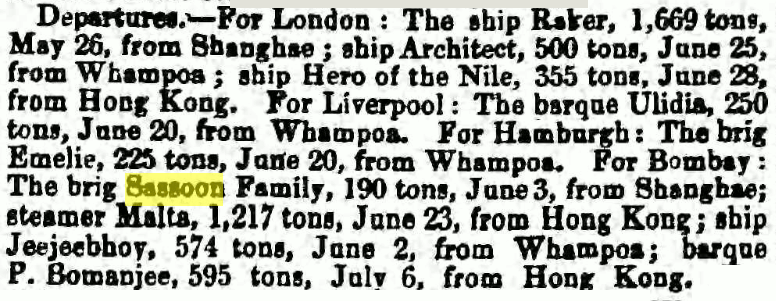
London Morning Post
- August 29, 1853 |
- But the truth was much darker, between 1840 and 1858,
opium imports to China increased by 400%.
- The number of
opium addicts grew from roughly 2 million to over 10 million.
-
Entire regions of China saw their economies collapse as
Chinese chose opium over food.
- Silver drained out of
China to pay for the drug.
- The Qing dynasty weakened and
fortunes like the Sassoon's grew exponentially.
- David
Sassoon kept meticulous records and the family archives now
scattered between London and Mumbai, showed that he understood
exactly what he was doing.
- But the people who saw the
Sassoon name on public buildings thought what genorous people
they were.
|
The Qing Dynasty (1644–1912) was China's final imperial dynasty, established by the Manchu people, known for its vast territorial expansion, population growth, and cultural achievements during its early "High Qing" period (under Emperors Kangxi, Yongzheng, and Qianlong) but ultimately weakened by internal rebellions (like the Taiping Rebellion) and foreign pressures (like the Opium Wars) leading to its collapse with the Xinhai Revolution and the abdication of the last emperor, Puyi, in 1912.
(Assistant)
|
Market cultivation |
- Letters that David Sassoon sent to his sons discuss
market cultivation which meant creating new addicts.
- He
talked about suppressing local cultivation, which meant
collaberating with British authorities to eliminate Chinese
dealers who didn't buy from the Sassoon's.
- One letter in
1851, is particularly chilling where he wrote to his son Elias
in Shanghai, 'the recent enforcement action by British patrol
has cleared the market of irregular suppliers.'
- He went
on to say that their prices had risen 23% as predicted and he
recommended maintaining current volume until local production
attempts were suppressed.
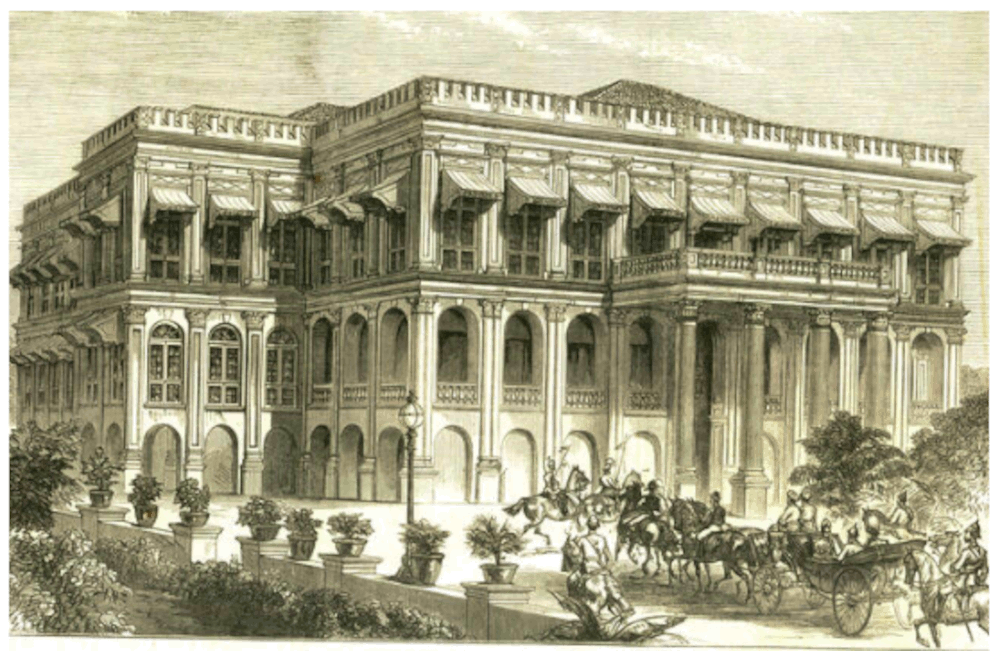
Sans Souci family
home in Bombay |
- What he was referring to in the letter was that the
British Navy had destroyed Chinese opium dealers, creating a
supply shortage that let the Sassoon's raise prices and
increase profits.
- By 1858, David Sassoon was the richest
man in Bombay.
- His mansion, Sans Souci overlooked the
harbor and British governors attended his dinners.
- His
sons married into other prominent Baghdadi Jewish families,
creating an interconnected merchant aristocracy.
- By that
time, the Sassoon trading empire controlled an estimated 70%
of the opium trade between India and China.
- One family,
one commodity, and near total market dominance.
|
The Sassoon Mansion "Sans Souci" refers to the grand Bombay residence of wealthy Jewish merchant David Sassoon, named after Frederick the Great's palace in Germany, symbolizing his immense success in colonial India before being converted into Mumbai's Masina Hospital. It hosted legendary events and was a center of the family's vast business empire, representing the "Rothschilds of the East," but the name also links to the historic Sans-Souci Palace in Haiti, a different, ruined royal palace.
(Assistant)
|
Estates |
- By the 1860s, the Sassoon's were purchasing estates
across England and mansions in London, country homes with
sprawling grounds.
- Properties that put them in the same
social circles as Dukes and Earls.
- Albert's son, Reuben
Sassoon became best friends with the Prince of Wales, the
future King Edward VII, they attended the same parties and
vacationed together.
- Meaning that the heir to the British
throne was hanging out with the son of a drug dealer.
-
Edward VII even visited the Sassoon mansion in Bombay in 1875.
Philanthropy is fake charity |
- The British loved this arrangement because their empire
'lifts' people up, the Sassoon's were the perfect proof of
concept.
- Look at these Baghdad 'refugees' who became
pillars of society!
- It was the Victorian concept of
billionaire philanthropy today, using false 'charity' to
launder your reputation.
- All while the exploitation
continued.
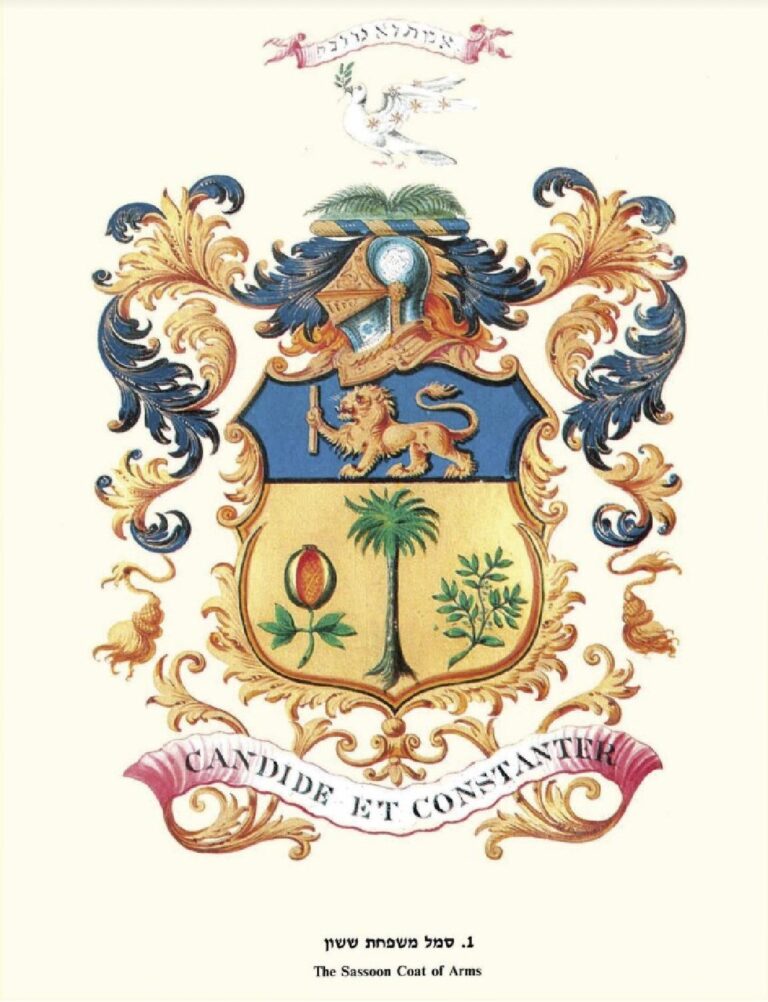
Sassoon family
crest |
- And if the story wasn't insane enough, the Sassoon's
married into the Rothschild family after Albert's son married
a daughter, uniting two of the most powerful, corrupt Jewish
dynasties in the world.
- Think about that alliance for a
second, the Rothschild's financed European wars and
governments and the Sassoon's provided the opium that balanced
Britain's trade deficits.
- Together, they were integral
to the machinery of the British Empire, one family controlled
money while the other controlled drugs.
- It was the
perfect partnership and Albert Sassoon even commissioned a
family crest, featuring a poppy, the source of the family
income.
- He wasn't hiding what made him rich, he was proud
of it.
Raise prices and
profits |
- David Sassoon knew something crucial, that
empires built on a single commodity are fragile.
- Opium
had made them rich, however, Shanghai was about to make the
family invincible.
- When David Sassoon died in 1864, at
age 72, he left an empire worth approximately $500,000,
roughly $75 million in today's equivalent.
- His sons
divided the business, Albert Abdullah took Bombay operations, Elias
took Shanghai.
- But it was Elias, quiet and methodical who
would transform Shanghai from a port created by a war treaty, into the Sassoon family's greatest achievement.
More than a trading
post |
- Shanghai wasn't just another trading post, it was the
future, and the Sassoon's were about to own it.
- In 1845,
Shanghai wasn't a city, it was mud, literally.
- The Bund,
that famous waterfront that would become Asia's most valuable
real estate, was a river bank covered in reeds where Chinese
fishermen pulled boats onto the shore.
- The total foreign
population was maybe 50 people and there were no buildings, no
infrastructure, and no government beyond a confused Chinese
magistrate who didn't understand why the British treaty
suddenly gave foreigners the right to live there.
- Elias
Sassoon arrived in this chaos and saw opportunity.
|
The Bund, Shanghai's iconic waterfront, became Asia's "Wall Street" and financial hub, symbolizing colonial Shanghai's booming trade, banking, and Western influence with its grand European-style buildings contrasting its modern skyline. This historic embankment on the Huangpu River, once a muddy towpath, transformed into a powerful center for foreign powers, hosting banks, trading houses, and luxury hotels, making it a key site for global commerce in the early 20th century.
(Assistant)
|
Treaty port |
- The Treaty of Nanking was important because when Britain
defeated China in the 1st Opium War, they didn't just want
Hong Kong, they wanted treaty ports.
- Cities where
foreigners could live, trade and operate under their own laws.
- Shanghai was one of five, but unlike Canton which had
centuries of trading tradition, Shanghai was new, undefined,
up for grabs.
- The British established the Shanghai
international settlement, north of the old Chinese city.
- They
literally drew lines on a map and told the Chinese, this is
foreign territory, Chinese law doesn't apply, and that the
Chinese
would report to a consular government run by foreigners when
they went there.
First office on the
Bund |
- In this legal vacuum, the Sassoon't built their empire,
Elias arrived with capital, connections and a clear mandate
from his father.
- This was to establish a permanent
Sassoon presence before competitors even understood Shanghai's
potential.
- His first office was a wooden shack on the
Bund, 4 rooms and a dirt floor, but the location was
perfect, right at the intersection of where the Huangpu River
met the Yangtze, the main artery into China's interior.
-
The initial business was pure opium and ships from Bombay
would arrive carrying chests of Patna and Benares opium.
-
Elisha would store the chests in Chinese warehouses and then
distribute to Chinese compradors, middlemen who handled the
actual sale to addicts and opium dens.
|
The Huangpu River, a major tributary, flows north through Shanghai and meets the vast Yangtze River at Wusongkou, near the Yangtze's mouth where it empties into the East China Sea, forming a significant waterway for the city. This confluence, marked by the iconic Bund waterfront, is where the bustling urban life of Shanghai directly interfaces with the immense Yangtze, connecting inland China to the world.
(Assistant)
|
Consumer |
- The Sassoon's never directly sold to Chinese consumers
because it was too risky and too visible.
- Instead, they
supplied the network, controlled the flow and owned the
infrastructure.
- By 1850, Elias had established multiple
opium warehouses along the Huangpu River and he built a proper
office building on the Bund.
- Stone construction, two
stories, prominently displaying the Sassoon name in English,
Hebrew and Chinese.
- He employed a staff of 30, mostly
Parsi and Baghdadi Jews brought from India.
- What's
interesting is how the Sassoon's positioned themselves
socially, they weren't just merchants, they were community
builders.
First synagogue |
- Elias donated funds for Shanghai's first synagogue in
1850, and he hosted dinners for British consular officials.
- He married Leah Gubbay, daughter of another prominent
Baghdadi Jewish merchant, creating family alliances that
strengthened trading networks.
- But the real
transformation came after 1853 when a massive outbreak called
the Taiping Rebellion erupted in China.
- What was worse,
it was all about religion mixed with politics.
- Rebels captured
Nanjing and threatened Shanghai, millions died and the Qing
dynasty tottered on the brink of collapse.
- In the midst
of the chaos, the Sassoon's made their most important
decision, they stopped being just opium traders and became
real estate developers.
|
The Taiping Rebellion (1850-1864) was a massive civil war in China, a religiously-driven uprising against the ruling Qing Dynasty, led by Hong Xiuquan, who believed he was the younger brother of Jesus Christ, tasked with establishing the "Heavenly Kingdom of Great Peace" (Taiping Tianguo). This brutal conflict, which mixed Christian theology with Chinese tradition, promised land reform and equality, attracting millions of peasants and disenfranchised people, but ultimately failed, causing an estimated 20-30 million deaths and becoming one of history's bloodiest wars.
(Assistant)
|
Real estate
developers |
- War is terrifying for most, but for the Sassoon's it was
a huge opportunity.
- As Chinese fled Shanghai's old city
and wealthy Chinese merchants desperately needed safe haven,
the international settlement offered protection.
- Foreign
gunboats patrolled the waterfront and guarded the settlement
borders.
- At that time, if you had money and you wanted
safety, you moved to the foreign concessions.
- Elias
started buying land, lot's of it, entire city blocks for
prices that seem absurd now, a few hundred dollars per acre.
Swamp |
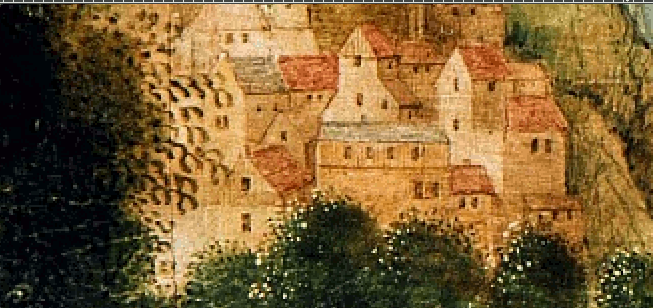
- But this was swamp land, undeveloped mud that needed
extensive drainage and construction.
- Most merchants
thought he was crazy because why invest in construction
projects when you can flip opium for 400% margins.
- But
Elias understood something they didn't, Shanghai was about to
go through a population explosion.
- The treaty ports
weren't temporary arrangements, they were permanent, the
British weren't leaving.
- As China modernized, or was
forced to modernize, Shanghai was set to become the gateway,
the place where the East met the West.
- Where Chinese
merchants did business with foreigners and where capital
flowed.
Real estate
portfolio |
- By 1860, the Sassoon real estate portfolio in Shanghai
was worth more than their opium inventory.
- They owned
warehouses, office buildings, residential properties and they
leased to other foreign trading houses.
- Essentially, they
became Shanghai's landlords, however, they didn't abandon
their opium trade, not even close.
- Between 1858 and 1880,
opium imports to China increased from roughly 4,000 tons
annually, to over 6,500 tons and they controlled the majority
of the business.
- Their ships now numbering over 30
vessels, shuttled constantly between India and China.
London Evening
Herald - May 18,
1865 |
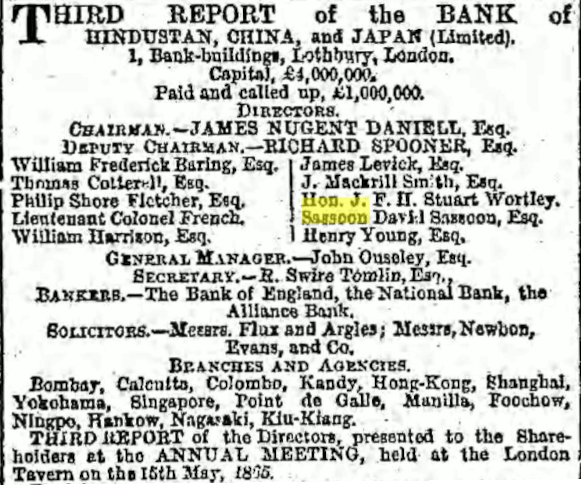
- The profits were astronomical and one contemporary
account from 1865 describes a single Sassoon opium auction in
Shanghai.
- The crowd gathered early, compradors and
dealers packed into the Sassoon auction hall.
- Elias presided
personally, his voice steady as he auctioned 500 chests in 3
hours.
- The total sale exceeded 600,000 tiles of silver,
roughly $800,000 in American currency, over half a million
profit in a single auction.
- That's roughly $9 million in
today's money.
- The moral questions were obvious, and Chinese
officials repeatedly protested.
Chinese officials
protested |
- Chinese scholars wrote treatises on how opium was
destroying their country.
- The emperor issued edicts,
useless, unenforcable edicts, banning the trade in British Shanghai.
- But the Sassoons had British military protection
and as long as Britain wanted the trade to continue, it would
continue.
- Elias handled these contradictions by simply
refusing to acknowledge them.
- In public, he spoke nobley
about bringing commerce and civilization to China, about
building infrastructure, about his charitable work funding
hospitals and schools.
- The opium trade was never
mentioned in polite company.
Next phase |
- What nobody knew, was how the family was positioning for
the next phase.
- Elias' younger brother, Albert Abdullah David
Sassoon, known as Abdullah the Younger, had returned from Oxford
University, anglicized, educated and ambitious.
- Unlike
his father and brothers, Abdullah was completely British in
mannerism and outlook.
- He wore British suits, spoke
English primarily and married a British woman and he saw that
the future of the Sassoon fortune wasn't just opium, it was
legitimacy.
Shanghai market |
- Abdullah began pushing the family to diversify by
investing in cotton mills, banking, and shipping legitimate
cargo.
- He wanted to use the opium profits to build
respectable businesses that could outlast the drug trade.
-
This created tension because the
Sassoon sons had built everything on opium, except for
Elias who moved them into real estate.
- They understood
the opium business and trusted it and knew how to manipulate
that market.
- Diversification meant risk and it meant they
would have to learn new industries.
Wall |
- In 1867, after David Sassoon died, the writing was on the
wall.
- Chinese government was getting stronger; the Qing
dynasty was implementing reforms, including building its own
military.
- Eventually, they would have the power to
actually enforce opium bans.
- The British might not always
be willing to fight wars over drug trafficking.
- The family
was divided, some members wanted to continue to maximize opium
profits while they could, while others wanted to transition to
legitimate businesses.
- So the compromise was both; keep
the opium flowing but invest in cotton mills, real estate and
banking.
Structural problems |
- By 1870, the Sassoon empire faced its greatest threat,
however, not from Chinese authorities or British competitors,
but from itself.
- When David Sassoon died in 1864, he left
behind a business worth approximately $500,000 and 8 sons who
each believed they deserved to run it.
- The partnership
agreement David Sassoon had created, meticulously designed to
keep the family unified, was about to be tested and it was
about to fail spectacularily.
- The problem was structural,
he had built an empire that required absolute unity.
Interconnected |
- Every branch of the business; Bombay operations,
Shanghai trading, the opium warehouse, the shipping fleet, the
cotton mills was all interconnected.
- Profits from opium
financed the mills which provided legitimate cover for the
trading operations.
- The shipping fleet served everything,
pull one thread and the entire fabric could unravel, but his
sons had different visions for the future, and different
levels of attachment to the source of their wealth.
-
Albert Abdullah Sassoon, the eldest son who inherited control of the
Bombay headquarters, wanted to maintain the traditional model
and keep the opium flowing.
- Maximize profits, and the
British empire protected the trade.
- China was too weak to
stop it, so why change what worked.
Albert Abdullah,
eldest son
of David Sassoon |
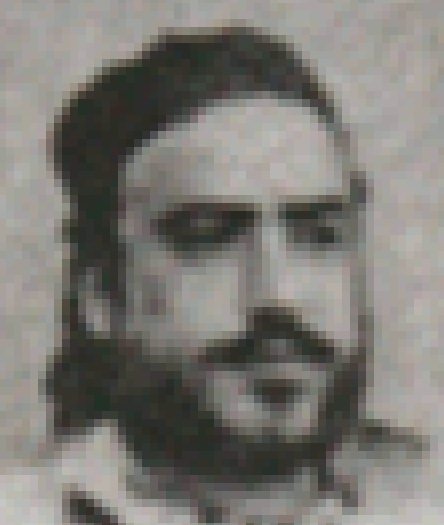
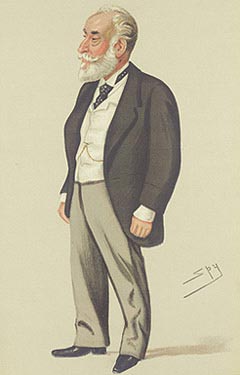
- Albert Abdallah Sassoon was born on July 25, 1818, in Baghdad, Ottoman Empire, into the Sassoon family of Baghdadi Jews.
- He was educated in British India.
- After his father's death, he served as head of his family's merchant company 'David Sassoon & Sons'
which was later called 'David Sassoon & Company.
Leslie Ward, Public domain, via Wikimedia Commons
Caricature of
Sir Albert Abdallah
David Sassoon
"The
Indian Rothschild" |
- Albert Abdullah David Sassoon was universally
called Abdullah the Younger.
- Educated partly in England,
Abdullah the Younger represented the next generation.
-
While he wasn't the youngest son (his brother Sassoon David
Sassoon was younger, born 1832), Albert represented a younger
thinking figure who dramatically expanded the family's global business and presence in England.
- He became the most famous Sassoon, leading the family's
'golden age' in the latter half of the 19th-century.
Ticking time bomb |
-
Abdullah the Younger looked at the opium trade and saw a
ticking time bomb.
- Not immediately, he wasn't naive about
the profits but long term, he believed that the trade was
unsustainable.
- Abdullah was a
conservative, traditional in dress, orthodox in religion and
suspicious of Western education.
- He viewed the family
business as his father had, a sacred trust to be preserved
exactly as built.
|
David Sassoon's eldest son was Abdullah David Sassoon, later known as Sir Albert Abdallah David Sassoon after receiving a knighthood, a prominent banker and philanthropist who succeeded his father but eventually split the family firm with his brother Elias, leading to separate successful branches of the Sassoon dynasty.
(Assistant)
|
Elias, son of David
Sassoon |
- Elias David Sassoon earned an immense fortune alongside his family and he was the founder of E. D. Sassoon & Co., a trading company he founded in 1867.
- Elias,
who ran the
Shanghai operations agreed with Abdullah but for different
reasons.
- He had spent decades building the distribution
networks in China and he knew every comprador, every
warehouse, every smuggling route.
- His entire expertise
was in opium and diversifying meant abandoning the knowledge
that made him valuable.
- So he pushed to expand the opium
trade, open new markets in interior China, undercut domestic
Chinese production, increase market share, even as total
volume might decline.
Family line |
- International pressure was building and China was
quickly modernizing.
- Eventually, the British government
would stop protecting opium traders because the diplomatic
costs would exceed the benefits.
- When that happened,
families who entire wealth depended on opium would be
destroyed.
- Abdullah the Younger's solution, diversify
aggressively by using opium profits to build businesses that
could outlast the drug trade.
- He wanted to diversify and
make the Sassoon name synonymous with commerce, not narcotics.
Brutal |
- This created immediate conflict because diversification
required capital.
- Capital which would otherwise be
distributed to family members but Abdullah the Younger wanted
to reinvest 60-70% of annual profits while the rest of the
family wanted to take their distributions and maintain their
lifestyles.
- The fights were brutal and family meetings in
Bombay devolved into screaming matches.
- Letters between
Bombay and Shanghai were filled with barely concealed
contempt.
Dualing brothers |
- At one point in 1867, Elias wrote to Abdullah,
'You speak of legitimacy like a man ashamed of his father's
work.'
- He went on to say that David Sassoon built the
family empire on trade the British Empire sanctioned.
-
Elias felt that Abdullah disguised cowardice as strategy and would
destroy what took decades to build.
- Abdullah wrote back
that he was speaking of survival whereas Elias was speaking of
pride in a business that made the family wealthy criminals in
the Chinese people's eyes.
- He believed that when the
British abandoned them, and they eventually would, the
Shanghai warehouses would be burned and turn to ashes and the
family would be penniless, right.
Modern mills |
- The breaking point came later in 1867 when Abdullah
proposed a massive investment, $100,000 to build modern cotton
mills in Bombay.
- Using the latest British technology, the
mills would be the largest in India, employing thousands and
producing textiles for both Indian and Chinese markets.
-
The return on the investment would take years, but once
established, the mills would generate steady profits
independent of opium.
- His brothers rejected the idea, too
expensive, too risky and too much capital tied up in unproven
ventures when opium was such a cash cow.
Family firm |
- In 1874,
Abdullah the Younger did something unprecedented, he split
from the family business and under his leadership established in Bombay a new subsidiary, the 'Sassoon Spinning and Weaving Company,'
which opened several cotton mills there.
- But Abdullah Sassoon (later Sir Albert Sassoon) didn't exactly
'split' from the family business in a destructive way but moved its center to London after becoming the head,
anglicizing his name and gaining titles.
- Meanwhile, his half-brother Elias David Sassoon (E.D.) created a rival firm, E.D. Sassoon & Co.,
in India after the disputes, causing the first major family rift and splitting the commercial empire into competing factions.
Competing
businesses |
- These weren't just separate businesses. they became
bitter enemies, competing for the same opium contracts and
undercutting each other's prices and sabatoging deals.
-
But they were both still peddling opium, competing with each
other to see who could addict more Chinese.
- Just imagine,
two branches of the same family, with the same last name,
competing with each other and trying to destroy each other
financially.
Modern mills |
- Elias took his own personal capital, borrowed
extensively, and several younger family members joined him,
however, most stayed with the traditional family firm, David
Sassoon & Sons.
- By the 1860s and 1870s, both branches continued trading opium,
creating competition, but the business eventually declined due to shifting markets and changing family priorities.
- This was a family civil war and Elias began buying
property that Abdullah wanted, and he also undercut him on
prices and stole employees.
- From there, it turned into
vicious infighting between younger generations, cousins, and boths sides spread
rumors.
- The traditional firm believed that Elias was
bankrupt and overleveraged, while Elias believed that the
original firm was morally bankrupt.
Property owners |
- But the traditional firm, David Sassoon & Sons,
continued to dominate the opium business and between 1867 and
1880 they increased market share as smaller competitors
failed.
- The opium profits remained extraordinary and the
family members who stayed with the traditional firm became
enormously wealthy.
- Abdullah the Younger built his cotton
mills, and they were profitable within 5 years, all the while
he was investing in real estate.
Cotton mills |
- By mid-1870s, the family firm owned 12 cotton mills in India and
employed over 20,000 workers and they were Shanghai's largest
property owners.
- The opium trade continued, but it was no
longer their only business.
- Elias formed banking
operations that financed British and Chinese merchants.
- They were gradually becoming
a diversified trading empire.
- Shanghai was becoming the
Paris of the East and the Bund was transforming from mud flats
to elegant stone buildings.
- Complete with electric
lights, hotels and banks.
- The Sassoon family owned much
of it and they were just getting started.
Wet docks |
- In 1875 the company built the Sassoon Docks, the first wet docks in Bombay
and the company was also instrumental in the founding of the Imperial Bank of Persia in 1889.
-
After a visit to England in 1873, Albert Abdullah Sassoon settled there permanently in 1875 to direct David Sassoon & Sons from London.
- The management of the company's affairs in Bombay was left to his younger brother Solomon David Sassoon (1841–1894).
- By the mid-1880s, Elias' E.D. Sassoon & Company was worth
approximately $300,000 and this he achieved in 13 years
without relying on opium.
Family splinters |
- The family spilt pushed both firms to excellence in
profiteering, however family gatherings became impossible and
weddings and funerals turned into cold formal affairs.
-
This caused the tight-knit Bagdadi Jewish community to
splinter, some siding with either side.
- The split also
caused complications in Shanghai, with 2 Sassoon firms
competing, it drove up prices for everything.
- This
internal family war eroded their dominance.
- Everything
turned into bidding wars and their main competitor, Jardine
Matheson, started gaining ground and by 1875, they had
increased their profits from 15% of the market, to 25%.
-
Although the Sassoon's still controlled about 65%.
Opium dominance |
- Between 1870 and 1895, the Sassoon family reached the
absolute peak of their opium dominance.
- These 25 years
represent the most profitable and powerful, and the most
morally indefensible period of the family empire.
- The
numbers are staggering, by 1880, China was importing
approximately 6,500 tons of opium annually and the Sassoon's
controlled an estimated 70% of this trade.
- That's 4,550
tons of opium moving through their warehouses, ships and
Sassoon distribution networks every single year.
- In
perspective, each ton of opium could supply roughly 15,000
addicts for a year.
Huge population |
- This meant that the Sassoon's were supplying, directly
or indirectly, enough opium for approximately 68 million
addicts annually.
- At that time, China's population was
about 400 million which means that the family was actively
involved in maintaining addiction for roughly 15% of China's
entire population.
- One family, one drug, millions of
ruined lives.
- The operation was sophisticated, the
Sassoon's didn't just ship raw opium and hope for sales.
-
They had developed an entire ecosystem, first with production
control.
- By 1870, they had representatives embedded
directly with opium growers in Patna and Benares.
Opium farm |
- They provided financing, seeds and equipment and
specialized knowledge.
- In exchange, growers were locked
into exclusive selling agreements.
- The Sassoon's would
purchase their entire harvest, this meant they could regulate
supply and restrict it when they wanted to push prices up, or
flood the market when they wanted to destroy competitors.
-
Next they were into quality standardization and they created a
grading system for opium.
- The first grade Patna became
the premium product with high morphine content, consistent
quality, packaged in distinctive Sassoon chests with the
family seal.
Financial
infrastructure |
- Chinese compradors knew that Sassoon opium was reliable.
- This branding mattered enormously in a market filled with
adulterated product.
- Their third focus was financial
infrastructure and the Sassoon's created banking operations
that financed the entire opium pipeline.
- They gave credit
to Chinese compradors, accepted payment in multiple
currencies, and hedged exchange rate risks.
- By this time,
they weren't just selling drugs, they were operating a full
service financial system built around narcotics.
- Their
next focus was in political protection and this is where their
story gets really dark.
Political
protection |
- The Sassoon's maintained extremely close relationships
with British officials.
- They hosted governors, donated to
British causes and in exchange, British gunboats made sure
that Sassoon opium shipments were never disrupted.
- One
incident in 1875, showed how this worked when a reformist
Chinese official in Jiangsu Province, began aggressively
enforcing opium bans.
- He arrested Chinese dealers who
sold Sassoon product and seized Sassoon warehouses.
|
Jiangsu is a coastal province in East China. It is
one of the leading provinces in finance, education,
technology, and tourism, with its capital in Nanjing.
Jiangsu is the third smallest, but the fourth most
populous, with a population of 84.75 million, and the
most densely populated of the 22 provinces of the
People's Republic of China. Jiangsu has the highest
GDP per capita and second-highest GDP of Chinese
provinces, after Guangdong. Jiangsu has a coastline of over 1,000 kilometers (620 mi) along the Yellow Sea, and the Yangtze flows through the southern part of the province.
(Wikipedia)
|
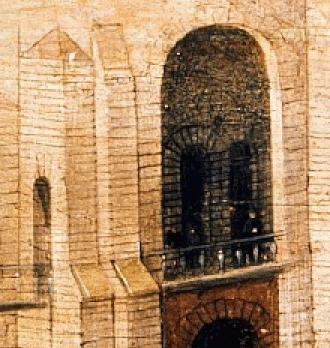
British consulate |
- The British consulate in Shanghai filed a formal protest
and when the Chinese official refused to back down, British
warships appeared off the coast.
- The official was removed
and the warehouses were returned to the family and business
resumed.
- Amazingly, the Sassoon's didn't even have to
request intervention, the British government did this
automatically because the opium trade generated so much
customs revenue that funding British colonial administration
depended on it.
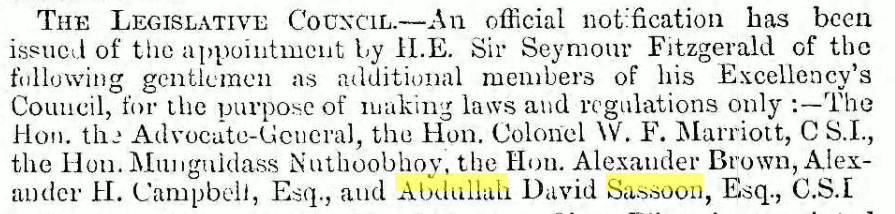
Aliens Indian Mail
- August 6, 1868 |
- Here's what's really twisted, while
poisoning millions with opium, the Sassoon's were
simultaneously celebrated as model citizens, philanthropists
and civilizers!
- In 1872, Abdullah Sassoon was knighted by Queen Victoria
of Great Britain and the newspapers praised his contributions
to Anglo-Indian commerce, the opium trade was barely mentioned.
- Instead, the coverage focused on his donations to hospitals,
schools and libraries.
- The Sassoon family cultivated this
dual image meticulously.
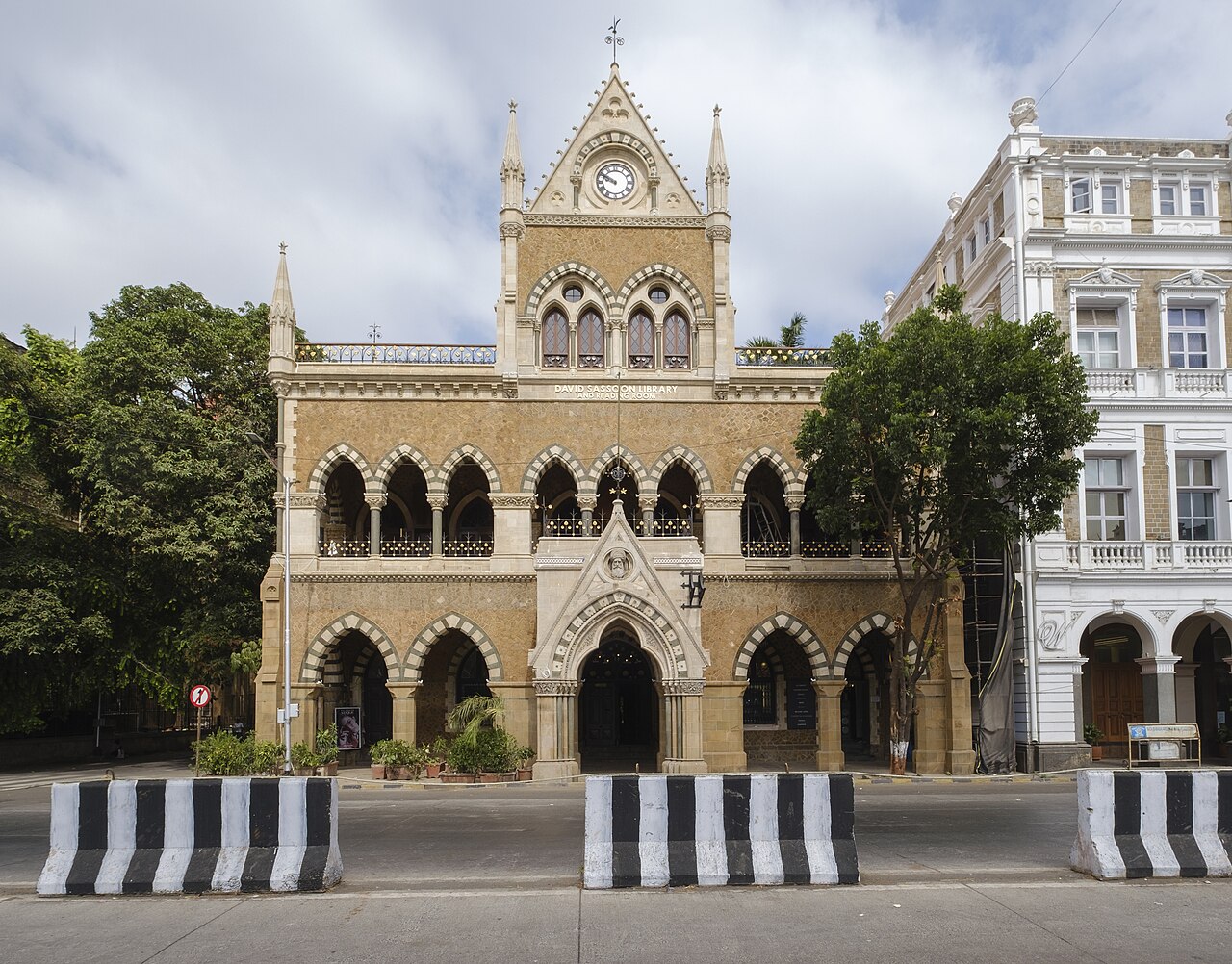
JSW Group, CC BY-SA 2.0 , via Wikimedia Commons
David Sassoon
Library |
- They built the Sassoon dock in Bombay, a massive
infrastructure project that employed thousands and they funded
the David Sassoon Library and Reading Room, still standing in
Mumbai today.
- The family donated to Jewish charities
across the British empire, how wide of them.
- Every act of
philanthrophy was public, celebrated and immortalized in
marble plaques bearing the Sassoon name.
- The opium, that
happened quietly in warehouses, on ships, and in the account
books that only family members saw.
- By 1885, the Sassoon
business empire was worth an estimated $2.5 million, which was
the equivalent to approximately $375 million today.
|
The David Sassoon Library and Reading Room is a famous library and heritage structure in Mumbai, India. The idea for a library to be situated in the center of the city came from Albert Sassoon, son of the famous Baghdadi Jewish philanthropist and businessman of the Sino-Indian opium trade, David Sassoon. (Wikipedia)
|
Wealth in assets |
- However, the real family wealth was in assets, the
ships, the warehouses, the mills, the real estate.
-
Shanghai properties alone were worth millions and they were
appreciating rapidly as the city grew.
- The population
there had exploded from 50,000 in 1845, to over 600,000 by
1890, and the international settlement was booming.
-
Western businesses were flooding in, banks, trading houses,
insurance companies and they all needed property.
- The
Sassoon's owned it, leased it, controlled it and the family
was also evolving, the 3rd generation, David Sassoon's
grandchildren were now running operations.
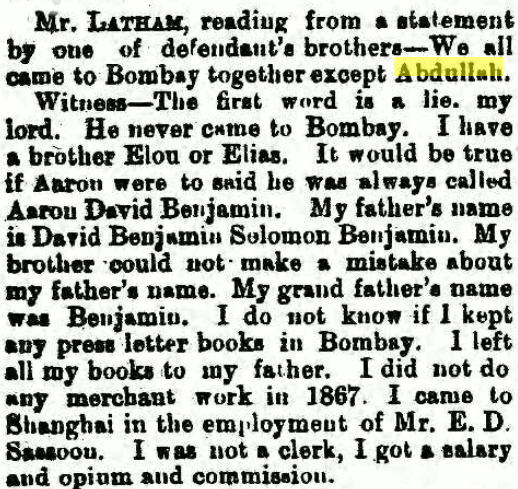
North China Herald
- January 26, 1887 |
- Grandson, Edward Sassoon had taken over the Indian business, Jacob
Sassoon managed banking and Victor Sassoon, born in 1881, was
being groomed to take over Shanghai operations.
- What's
interesting, is how the family maintained unity as most family
businesses fragment by the 3rd generation.
- They had a
system, everything was owned by David Sassoon & Sons, the
original partnership.
- Profits were distributed based on
complicated formulas based on seniority and contribution.
-
Nobody could sell their share without family approval.
- It
was a private network, accountable to nobody outside the
family, but cracks were appearing.
Cracks appearing |
- China was changing and the Qing dynasty, humiliated by
defeats in the Opium Wars, was attempting modernization;
building railroads, telegraph lines, and modern armies.
-
Increasingly, Chinese officials were arguing that opium was a
national security threat that had to be stopped.
- In 1890,
Chinese domestic opium production began competing with imports
and farmers in Yunnan and Sichuan provinces were growing their
own.
- It was lower quality, but much cheaper and without
import tariffs.
- The Sassoon market share was still
dominant, but for the first time it was being challenged, not
by foreign competitors, but by local Chinese production.
-
Elias died in 1880 and Albert Abdullah in 1896 and the
business passed to younger generations who were more
westernized than the older generations.
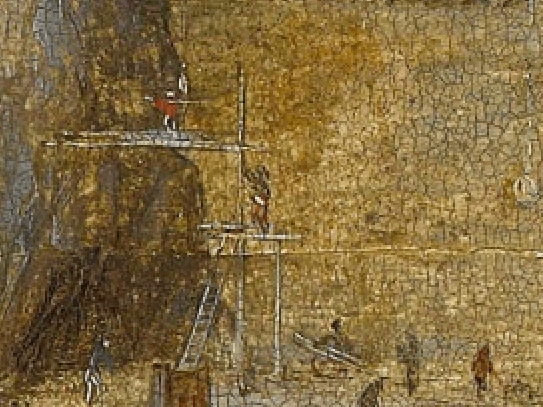
Construction
projects |
- Elias and E.D. Sassoon Company responded by doubling down on Shanghai real
estate.
- Between 1890 and 1900, they invested millions in
construction projects which included, office buildings, hotels
and apartment blocks.
- The Sassoon building on the Bund became
a landmark because it was not only massive, but modern, with
both offices and luxury apartments.
- They bought entire
neighborhoods in the Hongkou district.
- The calculation
was clear, the opium business might eventually decline,
however, the real estate would only increase in value.
-
Shanghai was becoming China's financial capital, its
industrial center and the place where modern China was being
born and the family owned huge chunks of it.
|
Hongkou is a quiet suburb and home to the Shanghai Jewish Refugees Museum, a former synagogue with displays on the area’s history as a Jewish WWII refuge and ghetto. The 1846-built Astor House Hotel has a cocktail bar that's popular with tourists, while nearby Waibaidu Bridge, linking Hongkou to the Bund, draws visitors at night with its colorful lights. (Assistant)
|
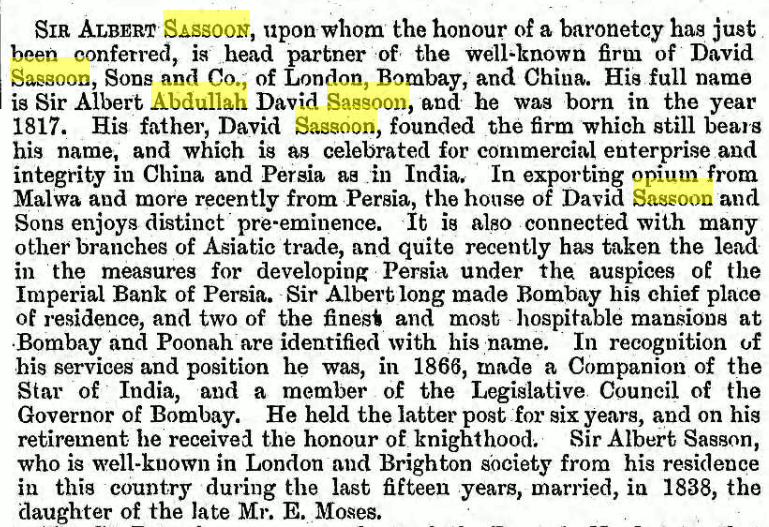
London and China
Telegraph - January
6, 1890 |
- By 1895, annual opium revenues for the Sassoon's had
actually started to decline slightly, down from peak profits
in the 1880s.
- The original firm, David Sassoon & Company
began to diversify too late and struggled as the opium
business declined, they did not fare as well as Elias.
- By
1920, David Sassoon & Sons was a shadow of its former self.
-
However, because E.D. Sassoon Company diversified early and real estate income was surging,
rental income from Shanghai properties alone, exceeded $500,000
annually and their cotton mills thrived.
Diversified |
- The family was transitioning slowly from drug
lords to landlords.
- But here's the thing, neither side
ever
stopped selling opium, even as they built legitimate
businesses, the opium trade continued.
- Because it was
still enormously profitable, and because they could.
-
Additionally, British military protection continued, and
Chinese enforcement remained weak and millions of addicts
needed their supply.
Sydney Evening News
- October 27, 1896 |
- One historical record from 1895 shows a typical Sassoon
shipment; 3 ships carrying 800 chests of opium departed
Calcutta for Shanghai.
- The moral reckoning never came,
not for the elder Sassoon's, not in their lifetime.
- They died
wealthy, honored and respected.
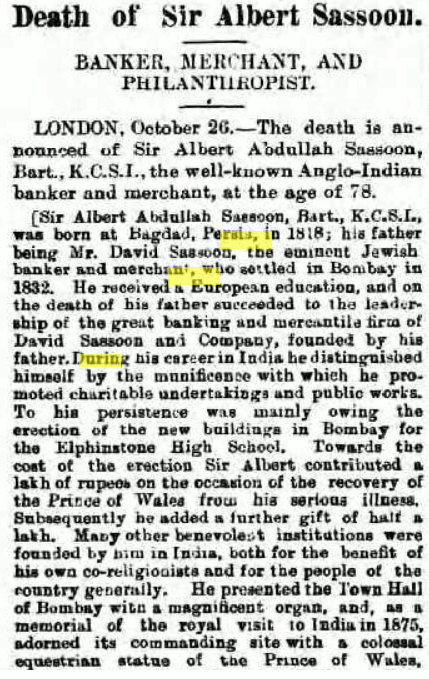
- Abdullah Sassoon died in
1896, lorded in obituary's as a 'merchant prince' and great
philanthropist.
- The millions of Chinese opium addicts
whose lives were destroyed funding that philanthropy weren't
mentioned.
- But the empire's dominance was about to be
tested because the 20th-century was coming, and with it, wars,
revolutions and changes that would shake even the mighty
Sassoon empire to its foundation.
Memorializing |
- But in an ironic twist, despite all their wealth and
titles, the Sassoon's could never really escape their origins.
- They tried desperately to become British, speaking English
at home, dressing in European fashion and abandoning much of
their Jewish and Baghdadi traditions.
- Some family members
became so assimilated, they were embarrassed when family
members from India visited them in London.
- By the 1890s,
the Sassoon empire should have been unstoppable, they had
wealth, connections and a global network that spanned 3
continents.
- However, what always spoils dynasties,
eternal betrayal and the family split into 2 rival factions.
Vast wealth |
- There are accounts of Sassoon descendants, literally
hiding their Indian connections.
- Pretending their fortunes came from trade
without specifying what kind of trade.
- They had
everything money could buy but they were trapped between two
worlds, too brown for Victorian England, yet too wealthy and
westernized for their own community.
- The family
sold their souls for acceptance into a system that would never
truly accept them.
- One descendant called their wealth,
money made in the East by dirty trading, showing they knew
what they'd done.
Hospital
|
- By 1920, 40% of the Chinese were addicted and at the
same time, family members continued to be knighted by the
British royals.
- Not only did the Sassoon family control
70% of the opium supply, they created 14% of Britain's Indian
revenue.
- They did it all while at the same time building
hospitals with their blood money.
- But what's the most
insane about the story, is that millions still praise them as
philanthropists.
- This is the story about how one Jewish
family weaponized addiction and bought their way into European
nobility, and then vanished into the shadows, possibly still
controlling vast fortunes that can no longer be traced.
Collapsing dynasty |
- China's Qing dynasty collapsed in 1911 and World War I
disrupted global trade and anti-opium movements gained
strength internationally.
- The British government began
publically distancing itself from opium trade and
international agreements forced them to sign agreements
limiting opium trade.
- For a brief time, the family
business became richer and more powerful than ever, however,
by 1920 opium trade for imports had dropped to a 33% of the
peak levels.
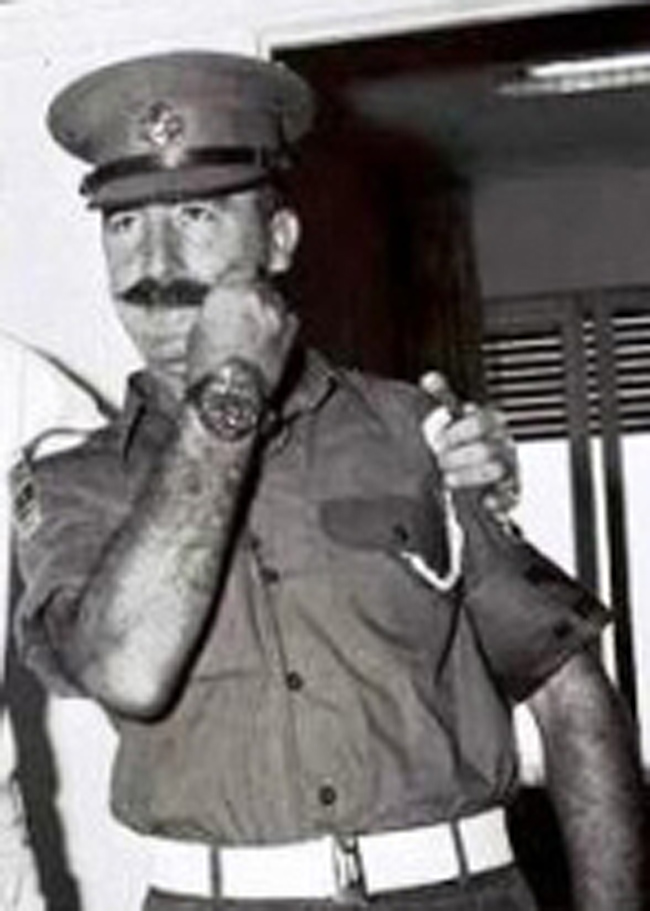
דוד טאוב, CC BY-SA 4.0 , via Wikimedia Commons
Victor Sassoon |
- Ellice Victor Elias Sassoon (1881-1961), a grandson, took control in 1924 and he
was running a diversified company that didn't rely on opium.
- On the death of his father, Sassoon inherited the trading house
E.D. Sassoon & Co. Limited.
-
He was very different than his predecessors, a playboy who ran
the company with ruthless efficiency.
- Victor used the
remaining opium accumulated capital, to purchase trophy
assets, not just any real estate, the most visible and
prestigious.
- Shanghai experienced an explosive growth
between 1920 and 1937 and the population doubled to 3.5
million.
|
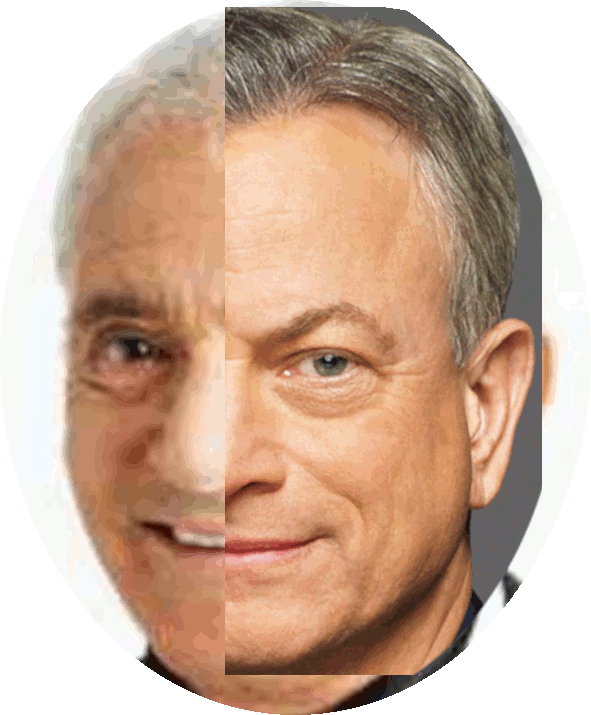
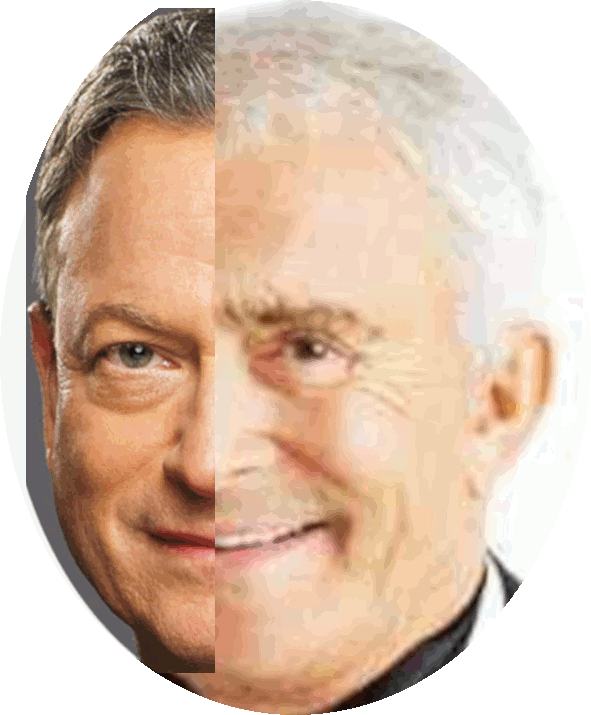
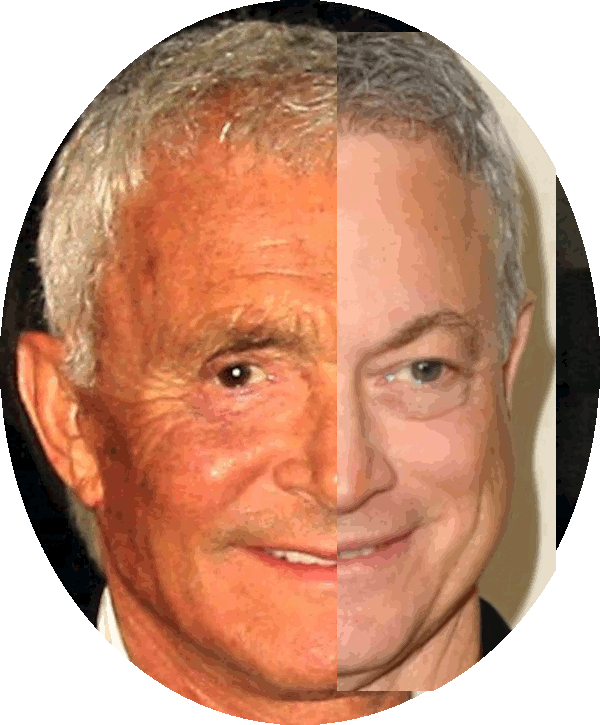
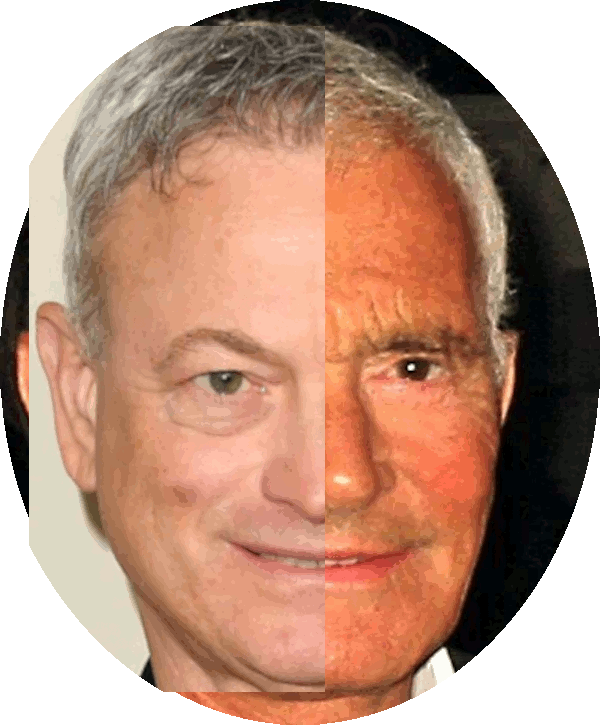
Gary Sinise as Vidal Sassoon |
 |
 |
Gary Alan Sinise
1955
3/17
Actor |
Vidal Sassoon
1928-2012
1/27
5/9
Hairdresser |
 |
 |
|
Heir dresser |
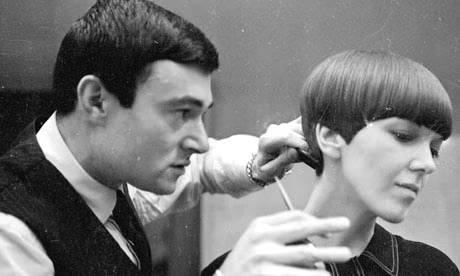
Masonic demonic hand sign |
- Sassoon was born to Jewish parents in Hammersmith, West
London, and lived nearby in Shepherd's Bush.
- His mother, Betty (Bellin) (1900–1997),
an Ashkenazi Jew, was born in Aldgate, in the East End of London, in 1900.
- Five-point cut.
|
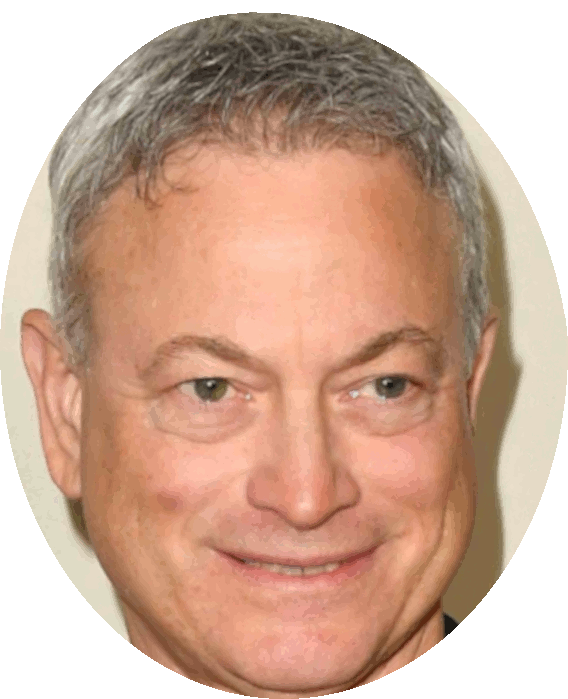
Gary Sinise as Vidal Sassoon |
 |
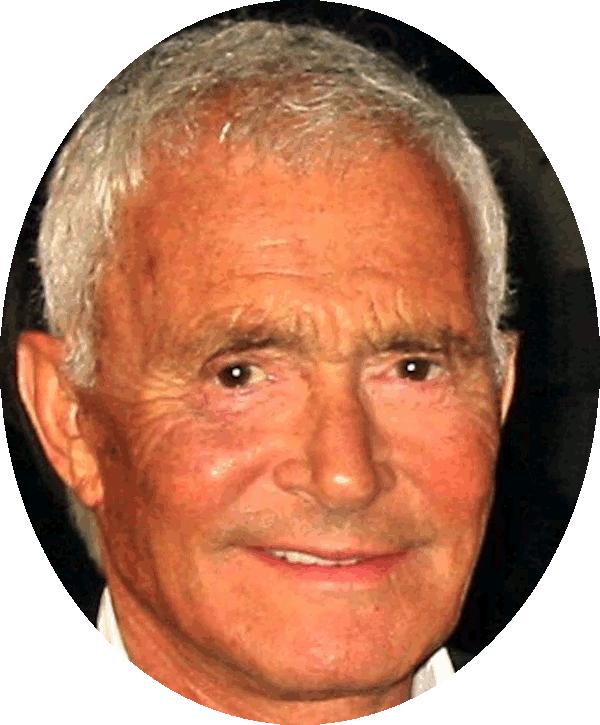 |
Gary Alan Sinise
1955
3/17
Actor |
Vidal Sassoon
1928-2012
1/27
5/9
Hairdresser |
 |
 |
|
Head demon |
- Not related to the drug lords (right).
- Must be
where Jay Sebring learned the trade.
Underworld |
- As the opium trade died, Victor Sassoon invested in
hotels and also was willing to operate in moral gray zones and
Shanghai was nicknamed the 'whore' of the Orient.
- He
invested in Shanghai's nightclub district, in casinos and
brothels where he cultivated relationships with the criminal
underworld.
- By then, the Green Gang controlled
prostitution, gambling and what remained of the opium business
and Victor Sassoon did business with them.
- They operated
outside British and Chinese law and he used their strength to
resolve property disputes or enforce contracts.
|
Victor Sassoon lived in Shanghai as a "wealthy bon
vivant who worked tirelessly to protect Western
interests in the Orient" and helped European Jews survive in the Shanghai Ghetto. Sir Victor walked with the aid of two sticks as the result of injuries in World War I in which he served in the Royal Flying Corps. He founded the Cathay Hotel (now the Peace Hotel) but left under increasing Japanese pressure in 1941. (Wikipedia)
|
Different ideas |
- In the end, Albert
Abdullah the Younger was right about diversification, but he paid for that
vindication with a permanent family arrangement that was
split.
- In 1949, everything changed, Mao Zedong's (1893-1976)communist
forces won the Chinese Civil War and the new governmant had
very different ideas about foreign capitalists.
-
Especially those who'd grown rich off of Chinese suffering.
- When the real threats came, Japanese invasion, communist
revolution, the fractured Sassoon empire broke for good.
- The Chinese under Mao nationlized everything and they seized
younger generation, Victor Sassoon's billion dollar empire,
the Sassoon hotels, office buildings, warehouses, mansions.
- Now property of the People's Republic, the family that had
spent a century extracting wealth from China, had everything
taken in a single year.
Sassoon name on
everything |
- Victor Sassoon fled Shanghai in 1941 with whatever portable
wealth he could carry and the E.D. Sassoon Company never
recovered.
- By the 1970s, it existed as a minor trading
firm with a famous name, but no real power, the Sassoon empire
was over.
- But what's the most irritating, if you walk
through Mumbai today, their name is plastered everywhere;
David Sassoon Library, Sassoon Docks, Sassoon Hospital and
beautiful Victorian buildings that tourists photograph and
locals use daily.
Maximize profits |
- Almost nobody knows what paid for all these Sassoon
memorials,
the plaques all say 'philanthropist.'
- They say benefactor
of Bombay and some even call David Sassoon the 'father of
Bombay' but they don't mention the millions of lives
destroyed, or the families torn apart by addiction.
-
Create addiction, maximize profit, use philanthropy to
whitewash your reputation and when it all falls apart, hide
behind lawyers and bankruptcy protection.
- The Sassoon's
trafficked opium for 120 years and received British
Knighthoods.
Moving wealth |
- Historians claim that the Sassoon dynasty collapsed in
the mid 20th-century, the Shanghai assets were seized and the
mills were sold.
- The family scattered across London,
Paris and New York and that's that, but some financial
historians aren't convinced because the Sassoon's were
extraordinarily sophisticated with money.
- They didn't
just make wealth, they moved it, hid it through investing in
trusts and layers of companies.
- By the early 1900s, they
had operations in banking, insurance, real estate, and
maritime shipping across 4 continents.

Quiet rich |
- When you have that much wealth, and globally
distributed, and all legally protected, it dosen't just vanish
because one branch of the business failed.
- Generational
wealth at that level doesn't just disappear, it goes
underground and becomes invisible.
- To this day, there are
traces of the Sassoon's still seen through trusts and
businesses, however, they can't be proved.
- The families
learn that flashy displays of wealth bring scrutiny, so they
become 'quiet' rich instead of loud rich.
Robber baron
sneaking away |
- Sassoon's in the 19th-century built hospitals with their
name, however, the Sassoon's of the 21st-century exist as a
financial entity, probably operating through anonymous LLCs
and offshore accounts that would take a forensic accountant
years to unravel and figure out.
- Which leads to the
questions, if someone makes a billion dollars destroying
lives, then donates 10% to charity, are they a philanthropist
or a criminal who's good at PR?
- Why do we name buildings
after robber barons and drug dealers just because enough time
has passed and they donated the money.
Philanthropist? |
- How many so-called respectable fortunes today are really
built on hidden exploitation that we just haven't uncovered
yet, or we forgot about.
- Is there any moral difference between what the
Sassoon's did in the 1800s, and what pharmaceutical companies
and social media platforms or exploitative hedge funds do
today?
- Here's what the Sassoon family proved, in the
right circumstances and with the right political connections,
you can commit atrocities on a massive scale, and not only get
away with it, you can be celebrated for it.
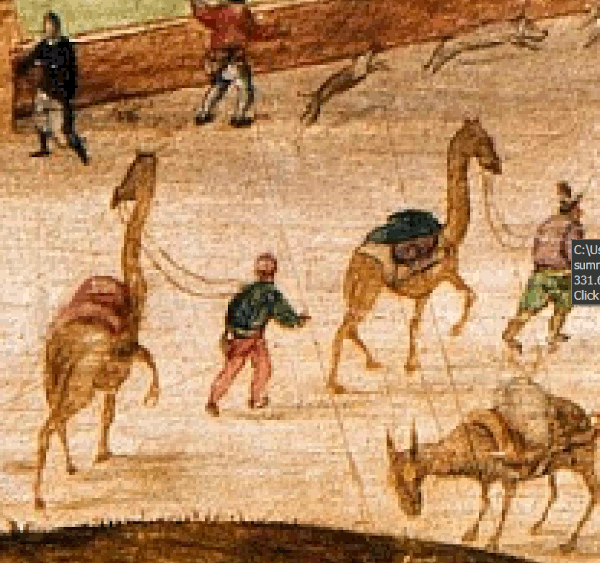
Trade policy |
- This family proved that philanthropy is the perfect
money laundering system, build enough hospitals and people
will forget where the money came from.
- Showing that if
you build enough hospitals, make enough royal connections, and
give enough political donations, that grants you immunity that
ordinary people will never have.
- And the system doesn't
punish you for being evil, it punishes you for being poor and
evil.
- If you're rich enough, evil simply becomes
controversial business practices, and massive addiction
becomes trade policy.
- Human destruction becomes economic
development and 150 years later, your victims are forgotten
while your name lives on buildings.
Generational wealth
lives on |
- This is the real lesson of the Sassoon empire, we don't
live in a world where good people succeed and bad people fail.
- Instead, we live in a world where successful money makers,
get to write their own narratives, despite who they harmed or
stole from.
- And that's what generational wealth does, the
fortune they built is likely still growing in trust funds in
the Caymen Islands, still compounding and still generating
returns, just more quietly.
- Because that's what
generational wealth does, it doesn't die, it doesn't
apologize, it just gets better at staying hidden.
|
They don't mention that every rupee Sassoon donated came from the largest drug trafficking operations. This is how power works, if you steal enough, and donate part of it back, people will build statues of you.
If your crimes are big enough and far enough away, you
become a historical figure instead of a criminal. The
Sassoon's understood this better than almost anyone in
history. (The Capital Historian Studio)
|
|
Not poppy, nor mandragora,
Nor all the drowsy syrups of the world,
Shall ever medicine thee to that sweet sleep
Which thou owed'st yesterday.
Shakespeare,
Othello

| |
 |
 |